Food Traceability Software: How to Choose
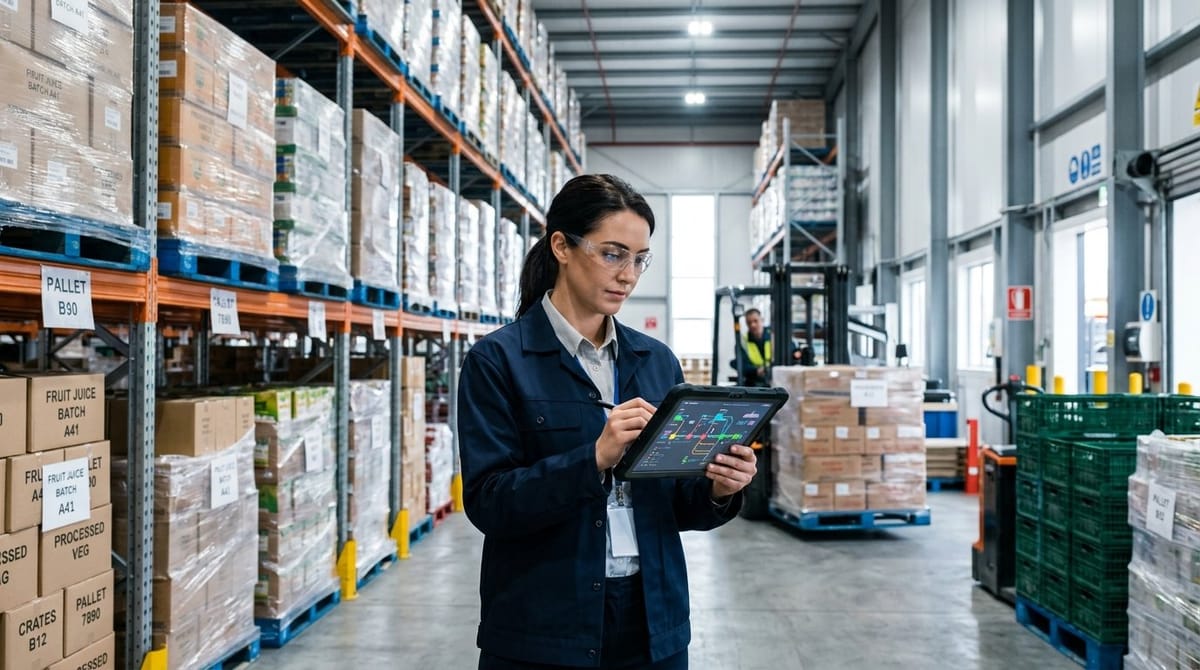
Food traceability software: how to choose the one that actually works
Choosing food traceability software is one of the most important decisions a quality manager in the food industry can make. It's not just about meeting regulations — it's about having the real ability to react within minutes to a food safety problem, protect the brand and sail through audits without surprises. In this article we'll help you understand what to look for, what questions to ask, and how to connect this tool with the rest of your management system.
What sets food traceability software apart from running it in Excel
The spreadsheet has one clear advantage: everyone knows how to use it. But when food traceability is managed in Excel, the problem isn't the tool — it's its structure. Files multiply, links between tabs break, data is entered manually with the risk of human error, and above all, the information isn't available in real time for the people who need it.
Dedicated food traceability software solves exactly those critical points. First, it centralizes all information in a single system: raw material intake, transformations, batch blends, packaging and shipment. Second, it automates the records tied to every product movement, removing the dependence on someone remembering to write something down. And third, it lets you run cross-referenced queries in seconds — something that in Excel can take hours when time is critical.
Another key difference is batch traceability. In Excel, linking a finished-product batch to the ingredient batches that make it up requires cross-referencing multiple files and depending on records being complete and properly named. A specialized system does it automatically, because every production step is linked to its source batches the moment it's logged.
Finally, there's the audit question. When an inspector or a customer auditor arrives, presenting a complete, consistent traceability file within minutes builds confidence. Presenting screenshots of spreadsheets full of manual formulas, not so much.
Must-have features in a food traceability system
Not every traceability system offers the same thing. Before evaluating options, it helps to be clear on the list of non-negotiable features. You can dig deeper into this in our guide on what food traceability is and how to manage it well.
Upstream and downstream traceability. A good food traceability system must let you trace the chain in both directions: from the finished product back to the source raw materials (upstream traceability), and from an ingredient batch forward to every product it was used in (downstream traceability). If the tool only supports one direction, it's not enough. Check out our practical guide to upstream and downstream traceability for a deeper look at how each type works.
Complex batch management. In the food industry it's common to blend batches of the same ingredient, split a batch across different production lines, or reuse semi-finished product. Batch traceability software must handle these situations without losing track of any component, keeping the relationship between every batch involved in each unit of finished product.
Product recall drill in minutes. This is, perhaps, the acid test. When faced with a food safety problem or a supplier alert, time is critical. An upstream and downstream traceability tool must be able to identify, in under thirty minutes, which products are affected, where they are, and which customers received them. If the system takes hours, it's not doing its job. In our article on how to manage a product recall without chaos we explain step by step how your company should be prepared for this scenario.
Integration with raw material intake. Traceability starts the moment the truck unloads. If the system isn't integrated with the goods-receipt log, the first link in the chain falls outside digital control and full traceability becomes impossible.
Automatic alerts and holds. A mature system doesn't just record — it acts: it automatically holds a batch when a non-conformity is detected, notifies the owner, and logs the reason. This keeps quarantined product from accidentally reaching the market.
Questions to ask a vendor before signing
The market is full of solutions that promise complete traceability. These are the specific questions you should ask in any demo to separate what actually works from what just sounds good in a slide deck.
How long does a real-time recall drill take? Ask them to run it during the demo with sample data. A well-designed system should display the affected batches, the products they were used in, and the customers who received them on screen in under five minutes. If the salesperson needs to prep it beforehand, or the system takes longer, that's a red flag.
How is raw material intake logged? Ask whether entering a supplier's delivery note automatically creates the batch in the system, or whether that's an extra manual step. The more manual steps, the higher the risk of data loss.
Does it handle batch blends and splits? Bring a real case from your own process: if you blend three different flour batches in a mixer, does the system know what proportion of each batch is in each unit of finished product? That level of granularity is what makes the difference in a recall.
Is it compatible with your current ERP? Isolated traceability has limited value. If the system doesn't talk to your ERP, your warehouse management software or your line scales, you'll end up with double data entry — the number one enemy of data quality.
How is information exported for an audit? Check that the system generates structured, exportable reports, not just query screens. Auditors need documentation they can review and keep.
How traceability connects to the ISO and GFSI audits you already have to pass
Traceability isn't an isolated module in your quality system. It's a central piece that connects directly to the requirements of the sector's most demanding certification schemes.
As set out in Regulation (EC) No 178/2002, laying down the general principles and requirements of food law (Regulation [EC] 178/2002, 2002), food business operators must be able to identify anyone who has supplied them with a food or ingredient and any business to which they have supplied their products, at every stage of the chain. This is the legal foundation of traceability in Europe, and auditors check it systematically.
In the context of the standards recognized by the Global Food Safety Initiative (GFSI, n.d.), such as BRCGS, IFS or FSSC 22000, traceability is a fundamental requirement assessed through documented drills. Auditors expect your company to complete a recall exercise within a predefined time, generally under four hours for 100% of the affected batches, backed by supporting documentation.
Well-implemented software turns this exercise — which used to require mobilizing several people for hours — into a structured lookup that any technician can run alone. That has a direct impact on your audit outcome and, above all, on your company's real ability to protect the consumer when it matters most.
Ultimately, choosing food traceability software well isn't just a technology question. It's a strategic decision that affects your product's safety, your quality team's efficiency, and your standing with customers and certification bodies. Take the time to ask the right questions before committing.
References
- Global Food Safety Initiative. (n.d.). Global Food Safety Initiative (GFSI). https://mygfsi.com/
- Regulation (EC) No 178/2002 of the European Parliament and of the Council of 28 January 2002 laying down the general principles and requirements of food law. (2002). https://eur-lex.europa.eu/eli/reg/2002/178/oj?locale=en