Packaging Traceability: What It Is and How to Manage It
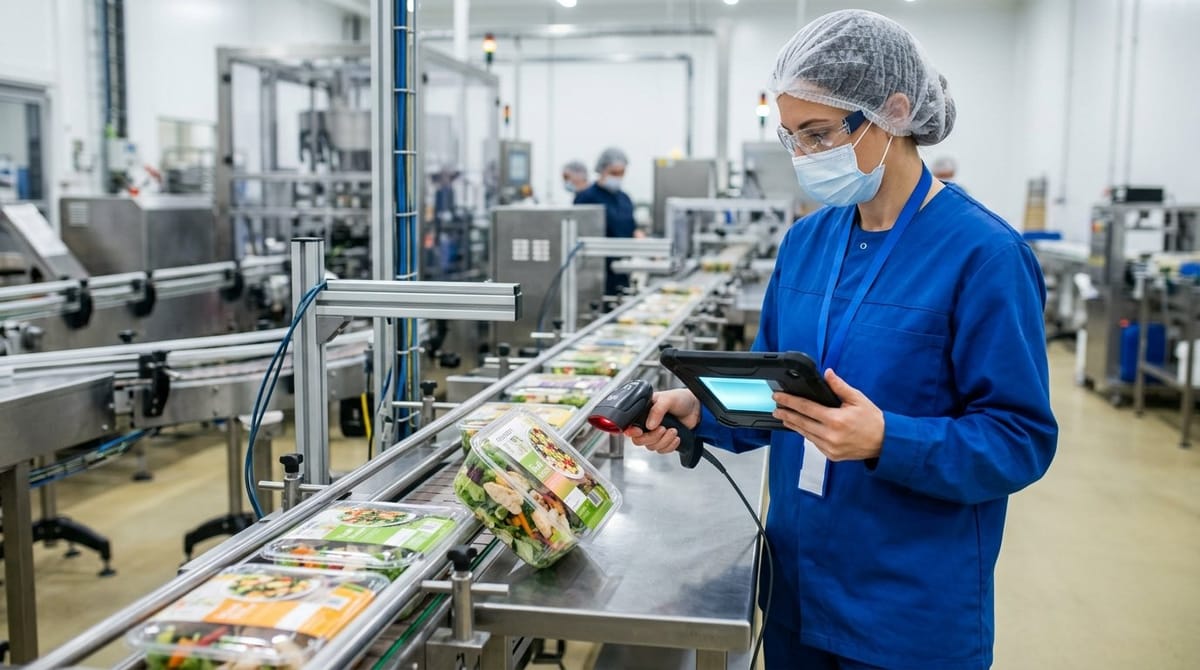
Packaging Traceability: What It Is and How to Manage It
When we talk about traceability in the food industry, the first thing that comes to mind is tracking the product: which batch the raw material came from, what process it went through, what date it was made. But there's an element that travels alongside the food from the production line to the end consumer that often stays off the radar: the packaging. Packaging traceability is the ability to link every package or container to its origin, its material characteristics, and the product it held, so its trail can be followed at any time and in both directions. In this article we explain what it involves, what information you need to record, and how to build it into your traceability system without multiplying your administrative workload.
What packaging traceability is and why tracing the product alone isn't enough
Packaging traceability goes beyond knowing that a product comes in a given package. It means documenting and keeping accessible the chain of information that connects the packaging to its supplier, its manufacturing batch, the material it's made of, and the food product it held. Put another way: if the product has traceability but the packaging doesn't, the system is incomplete.
The reason is simple. Packaging in contact with food isn't a neutral element — it can be a source of substance migration, it can be implicated in a supplier non-conformity, or it can be the origin of a health alert. If you can't identify which packaging batch was used in each production run at that moment, your ability to respond is compromised.
As set out in Regulation (EC) No 178/2002 (Regulation [EC] 178/2002, 2002), food business operators must be able to identify anyone who has supplied them with a food, a feed, a food-producing animal, or any substance intended to be incorporated into a food or feed. Packaging in contact with food falls into this category. Packaging traceability isn't, therefore, an optional best practice — it's part of every food company's legal obligations.
What information needs to be linked to packaging: supplier, batch, date and food-contact material
For packaging traceability to be genuinely useful in an audit or a crisis response, the record must contain, at minimum, the following data:
Supplier identification. Name, registration number and contact details of the packaging supplier. In the event of an alert, you'll need to reach them immediately and find out whether the issue affects other batches still in your warehouse or already on the market.
Packaging batch. This is what lets you cross-reference your system's information with the supplier's. Without a batch number, any investigation turns into a slow, costly process of elimination.
Receipt date. Lets you correlate when the material arrived with the production runs it was used in, making it easier to reconstruct the history when a problem surfaces days or weeks later.
Declaration of conformity for food-contact materials. Any packaging that comes into direct or indirect contact with the product must have a declaration of conformity certifying it meets current regulation on food-contact materials. This document must be linked to the corresponding packaging batch and be quickly retrievable.
Consumption per production run. Which packaging batch was used in each manufacturing order. This link is the heart of packaging traceability: without it, knowing you have a problem batch doesn't help you identify which finished products are affected.
Structured packaging control also makes it possible to catch material quality deviations before they reach the product: deformations, packaging contamination at intake, or gaps between the specification agreed with the supplier and what's actually received.
The risk of not tracing packaging: slower recalls and audits that don't add up
The lack of packaging traceability has practical consequences that show up at two key moments: when you need to manage a product recall, and when a certification audit arrives.
In a recall, minutes matter. If you get an alert from your packaging supplier that a batch may contain residues of a prohibited substance, you need to know within hours which production runs used that batch, which finished products are at risk, and where they are now. If that information doesn't exist or is scattered across paper sheets and emails, your response time multiplies — and so does the scope of the problem.
In audits against standards such as BRCGS Global Standards (BRCGS, n.d.) or other schemes recognized by GFSI, auditors verify that traceability covers every input in the production process, not just food raw materials. Packaging is an input. If you can't demonstrate which packaging batch corresponds to each production run during the traceability exercise, the system will show a gap that can turn into a major non-conformity.
On top of that, missing packaging records make internal investigations harder when consumer complaints related to packaging come in: deformations, odd smells, migration. Without traceability, you can't tell whether the problem is isolated or systemic, or whether it affects a single batch or an entire supplier reference.
How to link packaging traceability to product traceability without duplicating records
One common reason companies hesitate to implement rigorous packaging traceability is the fear of adding more bureaucracy. And it's true that if it's treated as a parallel, disconnected process, the volume of records can grow unmanageably. The key is to build it into the traceability system you already have, not bolt it on as a separate layer.
The natural integration point is the manufacturing order or the production record. Every time you log which raw materials were used in a production run, you should also log which packaging batch was consumed. A single extra field on the production sheet is enough to establish that link. From there, the system can trace in both directions: given a product batch, which packaging was used; given a packaging batch, which products it could affect.
Packaging management on the floor improves significantly once it's digitized. Quality software like Solved lets you log packaging receipts with their batch and associated documentation, link them to production orders, and automatically generate the traceability tree. This removes manual searching through files and cuts response time for any issue or traceability exercise.
Another important aspect is managing the packaging warehouse. For traceability to work in practice, packaging batches must be correctly identified in storage, with labels that let the operator record which batch they're using at any given moment. If packaging arrives without batch identification, or different batches get mixed on the same pallet, the data loses reliability even if the system is well designed.
Finally, it's worth including packaging in your supplier approval plan. An approved packaging supplier is one that, beyond meeting quality and safety requirements, guarantees it will deliver its products correctly identified and accompanied by the documentation needed to support your traceability. If you want to dig deeper into the fundamentals of the system, read our article on the importance of traceability in the food industry.
Packaging traceability isn't a luxury reserved for large companies — it's an essential part of any robust quality system. Building it in intelligently, linking it to your existing production flow and backing it with digital tools, lets you meet legal and certification requirements without adding to your quality team's administrative burden.
References
- BRCGS. (n.d.). BRCGS Global Standards. https://www.brcgs.com/
- Regulation (EC) No 178/2002 of the European Parliament and of the Council of 28 January 2002 laying down the general principles and requirements of food law. (2002). https://eur-lex.europa.eu/eli/reg/2002/178/oj?locale=en