Batch coding and lot definition: a practical guide
Batch coding and lot definition: a practical guide
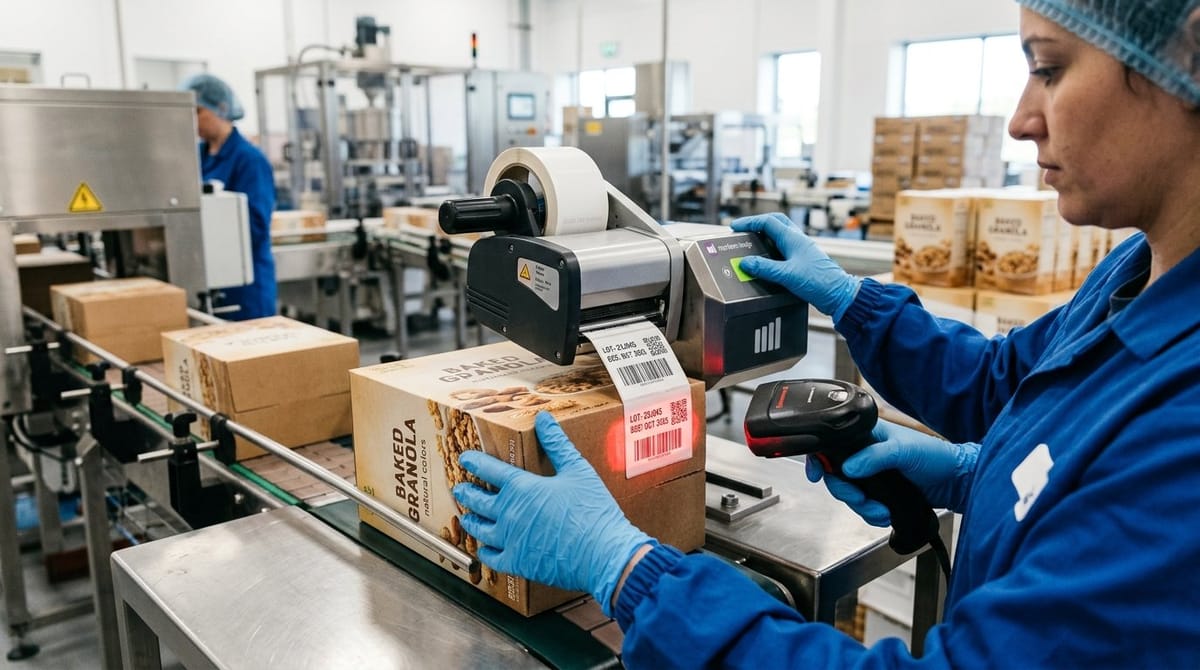
Batch coding and lot definition is one of the most critical tasks in any food production plant. It can look like a minor technical detail, but when a food safety alert comes in or a market recall has to be executed, the criteria used to define batches — and how they were coded — make the difference between pulling a hundred units or a hundred full pallets. In this article we explain what lot definition is, how to code a food batch correctly, and how to avoid the most common mistakes on the plant floor.
What lot definition is, and why a poor batch criterion complicates any product recall
Lot definition (or "loteo") is the process by which a company groups units of product under a single identifier — the batch number — so it can trace their origin, their journey and their destination at any moment. That identifier is the key that connects the finished product with the raw materials used, the production conditions, the quality checks performed and the customers it was shipped to.
A poorly defined batch criterion has very concrete consequences. Imagine grouping three consecutive shifts' worth of production into a single batch, using raw materials from different suppliers. If a non-conformity linked to one of those raw materials shows up, you won't be able to isolate the problem: you'll have to block and review the entire production of those three shifts, with all the financial and reputational cost that implies.
Batch traceability requires you to be able to identify and track any food item throughout the whole production, processing and distribution chain, as set out in Regulation (EC) No 178/2002 laying down the general principles of food law (Regulation [EC] 178/2002, 2002). To meet this obligation efficiently, a batch needs to be small enough to contain the scope of any issue, but large enough that managing it doesn't become administratively unworkable.
A good batch criterion usually takes into account variables such as the supplier and batch number of the main raw material, the production line, the shift, or the manufacturing date. The more of these factors are captured in the batch definition, the more precise your ability to respond to any problem.
How a batch is coded: what information it must carry, and what the regulations require
Food batch coding isn't a free choice: there's a legal obligation to mark products with a batch number that allows them to be identified. This requirement is part of the batch traceability system every food operator must have in place.
The batch number must appear on the product label and needs to be clear enough that both internal staff and the relevant authorities can use it to retrieve all the information associated with that production run. There's no single mandatory format, but there are widely adopted best practices in the industry.
A typical batch code in the food industry usually includes some combination of the following elements:
- Production date: in compressed numeric format, e.g. YYMMDD or the Julian day of the year.
- Shift or time slot: especially relevant in plants running continuous production.
- Production line: to distinguish between several lines making the same product at the same time.
- Product code or internal reference: to cross-reference the batch with the corresponding technical spec sheet.
For example, a code like 240915-L2-T1 could be read as: production from September 15, 2024, line 2, morning shift. This kind of structured coding makes searches and filters in any quality management system far easier.
From a regulatory standpoint, Regulation (EC) No 852/2004 on the hygiene of foodstuffs (Regulation [EC] 852/2004, 2004) requires food business operators to have documented procedures in place that guarantee the safety of their products, which includes being able to identify and withdraw any batch effectively. Consistent, well-designed coding is one of the foundations of that system.
Common mistakes when defining batches on the plant floor: batches that are too large, mixing, and duplicate codes
In day-to-day plant operations, the batch coding and lot definition process tends to concentrate a handful of recurring mistakes that seriously undermine traceability and the ability to respond to issues.
Batches that are too large. This is the most common mistake. Grouping several days', shifts' or even weeks' worth of production under a single batch number causes the potential scope of any problem to balloon. If a recall becomes necessary, the financial impact multiplies unnecessarily. The fix is to define tighter batches, even if that means managing a larger number of records.
Mixing raw materials from different batches without documentation. When an ingredient bag is swapped mid-production but the new supplier batch number isn't logged, the traceability chain breaks. The finished product ends up associated with an incorrect or incomplete raw material batch. This kind of mistake is especially common in long production runs or when the process relies on the shift operator's memory.
Duplicate codes. This happens when batch assignment isn't automated and codes are generated manually. Two operators on two different lines can assign the same code to different production runs, making it impossible to tell the correct product apart from one with a problem. Quality management software with automatic batch generation eliminates this risk at the root.
Inconsistency between the batch on the label and the batch in the internal system. This happens when the product label and the production documentation don't match. The mismatch can stem from typos, undocumented relabeling, or last-minute changes that weren't logged. In an audit or a product recall, this kind of inconsistency creates a very serious problem.
How to automate batch coding without relying on someone writing it down by hand
Reliance on manual logging is the root cause of most batch coding errors on the plant floor. The most effective way to eliminate that risk is to integrate lot definition into quality software that generates, assigns and logs batch numbers automatically, linked to the actual production process.
A well-configured system lets you define batch criteria once — date, shift, line, product reference — so the code is generated automatically when a production order is opened. That code is instantly linked to the raw materials used, the checks performed and, once production is complete, the recipients of the shipment.
The benefits of this approach are clear: transcription errors are eliminated, each code's uniqueness is guaranteed, the documentary trail needed for any audit is created automatically, and response time to a potential food safety alert drops from hours to minutes.
What's more, when the batch coding system is integrated with the traceability module, entering a single batch number is enough to instantly retrieve all the associated information: raw material supplier, production date and conditions, quality checks passed, quantity produced and the customers it was shipped to. This is exactly what current regulation requires and what auditors for any industry reference standard expect to see.
Implementing a solid batch coding and lot definition system isn't just a legal obligation: it's an investment in your company's ability to respond and in the trust you build with your customers and with regulatory authorities. The first step is to review the batch criteria you're using today and ask yourself: if an alert came in tomorrow, how much product would you have to block?
References
- Regulation (EC) No 178/2002 of the European Parliament and of the Council of 28 January 2002 laying down the general principles and requirements of food law. (2002). https://eur-lex.europa.eu/eli/reg/2002/178/oj?locale=es
- Regulation (EC) No 852/2004 of the European Parliament and of the Council of 29 April 2004 on the hygiene of foodstuffs. (2004). https://eur-lex.europa.eu/eli/reg/2004/852/oj?locale=es