ISO 9001 Traceability: A Real Practical Guide
ISO 9001 Traceability: A Real Practical Guide
ISO 9001 traceability is one of the pillars that raises the most questions among quality managers in the food industry. Not because it's a hard concept to grasp, but because translating it into daily operations — with consistent records, well-identified batches and a gap-free flow of information — takes method and the right tools. In this article you'll find a practical, straightforward guide to what the standard actually requires, how to organize backward and forward traceability, and how digitalization turns this requirement into a real competitive advantage.
What ISO 9001 requires on traceability
The ISO 9001 standard addresses traceability in clause 8.5.2, under the heading "Identification and traceability." The text is clear: when traceability is a requirement — whether legal, contractual, or self-imposed by the organization — the company must control the unique identification of process outputs and retain the documented information needed to enable it.
In other words, as set out in the ISO 9001 standard from the International Organization for Standardization (ISO, n.d.), traceability isn't an absolute requirement across every sector, but in the food industry European legislation makes it mandatory. Regulation (EC) No 178/2002 of the European Parliament and of the Council (Regulation [EC] 178/2002, 2002) requires every food company to be able to identify who supplied them with a food product and who they supplied it to, at every stage of the chain. In practice, this means that if you work in food, traceability is mandatory regardless of whether your company is ISO 9001 certified or not.
For quality managers, the value of building traceability into the ISO 9001 system lies in unifying control under a single management framework: policy, procedures, records, audits and continuous improvement. The result is a more robust, more auditable system.
Backward and forward traceability
When we talk about traceability in quality, it's essential to distinguish between its two directions, because each answers a different question and requires different data.
Backward traceability answers the question: where do this batch's ingredients or materials come from? It means logging suppliers, the batch numbers of incoming raw materials, intake date, receiving conditions and any non-conformity detected. Without this information, a food safety alert would make it impossible to locate the source of the problem within hours.
Forward traceability answers the opposite question: where has this batch or product gone? This covers shipping records, customers, quantities sent, dates and delivery-note or invoice numbers. This direction is what lets you pull a product from the market quickly and precisely when a risk is detected.
In the food industry, the two directions are inseparable. An effective quality control and traceability system must be able to trace the chain in both directions, from the farm or supplier all the way to the point of sale, and back again. You can dig deeper into this approach in our article on the importance of traceability.
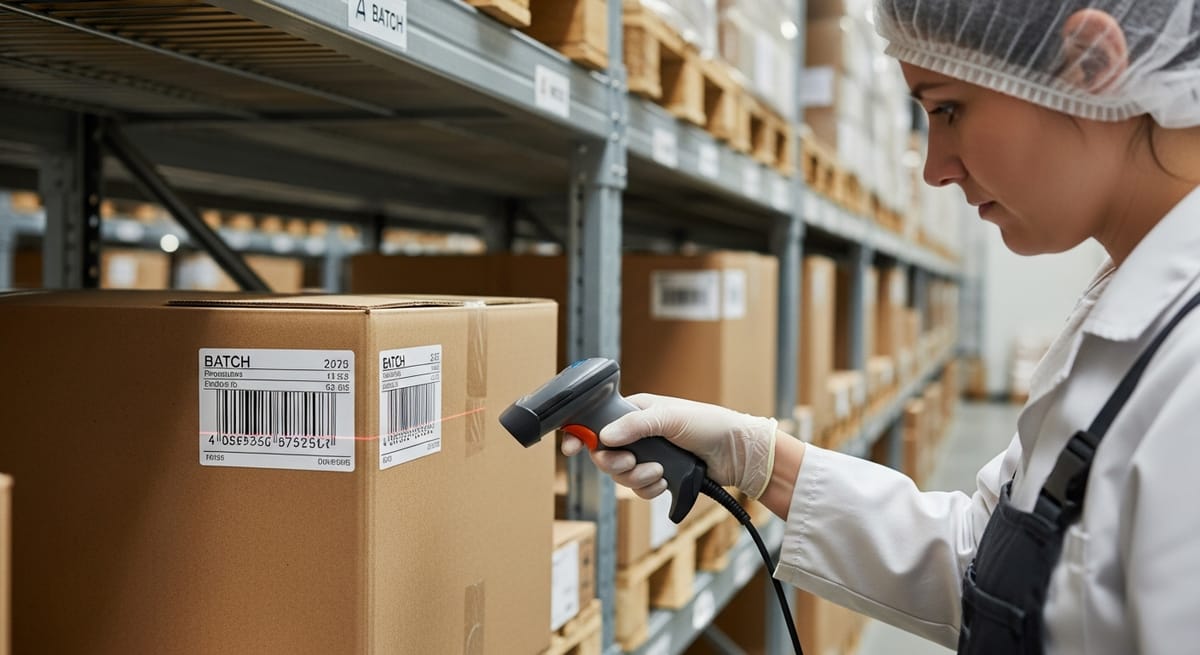
The practical key is to precisely define the control points where batch information is captured. In a processing operation, those points are typically: raw material intake, start of production, formulation or line changes, packaging and dispatch. If any of these points goes unrecorded, the traceability chain breaks.
How to document batches and records reliably
ISO 9001 traceability requires retaining documented information. But "documenting" doesn't mean piling up paperwork — it means records that are legible, identifiable, retrievable and protected against damage or loss.
Here are the good practices that separate a documentation system that actually works from one that exists only on paper:
1. Define a clear, unique batch coding system. The batch number should be interpretable by anyone on the team, even without checking another source. Including the production date and the line in the code makes handling issues much easier.
2. Log data at the moment it happens, not later. The most common finding in audits is discovering that records are filled in hours or days after the process actually occurred. This creates inconsistencies and invalidates traceability if an issue comes up. Logging must happen right when the event occurs.
3. Link every finished-product batch to its raw-material batches. This link is the heart of traceability. It can be done on paper with production sheets, but digital systems let you do it automatically, cutting human error.
4. Set appropriate retention periods. Traceability records must be kept, at minimum, for as long as the product can be on the market, plus an extra margin. In food, it's common to require between two and five years depending on the product type.
5. Run mock-drill exercises. At least once a year, put your traceability to a real test: pick a random batch and time how long it takes to reconstruct its complete history, both backward and forward. The results of that exercise are what really tell you whether the system works.
If you manage complex processes within the food industry, manual documentation can become a bottleneck that compromises both the reliability and the efficiency of the quality team.
End-to-end digital traceability with Solved
Digitalization has transformed the way quality teams manage traceability. Spreadsheets and paper records, while workable in small operations, show clear limitations once production volume grows or you need to respond to an audit or a real-time alert.
Solved is quality software built specifically for the food industry that lets you manage traceability end-to-end from a single platform. These are the capabilities that make the difference for quality managers:
Real-time logging. Operators log production and raw-material data at the exact moment it happens, from any device. This eliminates transcription errors and ensures the information is reliable.
Automatic batch linking. Solved automatically links every finished-product batch with the ingredient batches used, with no need to manually cross-reference multiple spreadsheets. The traceability chain builds itself while the team works.
Backward and forward traceability in seconds. When an issue or an audit comes up, the quality manager can pull the complete history of any batch in a matter of seconds. This doesn't just reduce stress in critical situations — it shows customers and certification bodies that the control system is solid.
Integrated alerts and non-conformities. If a deviation is detected in a batch — an out-of-range temperature, an out-of-spec test result — Solved lets you generate the non-conformity directly linked to the affected batch, making it easier to manage corrective actions and close the continuous-improvement cycle that ISO 9001 requires.
Audit reports. The system automatically generates traceability reports in the format and level of detail that ISO 9001, BRCGS, IFS or FSSC 22000 auditors need, saving hours of document preparation.
Implementing a digital solution like Solved isn't just about efficiency — it's an investment in the resilience of your quality system. When traceability actually works, teams gain confidence, audits become a demonstration of strength, and responding to an issue stops being a moment of chaos and becomes a controlled process.
If you'd like to see how Solved can adapt to your company's reality, request a free demo and see for yourself what it means to have traceability truly under control.
References
- International Organization for Standardization. (n.d.). ISO 22000 and ISO 9001. https://www.iso.org/
- Regulation (EC) No 178/2002 of the European Parliament and of the Council of 28 January 2002 laying down the general principles and requirements of food law. (2002). https://eur-lex.europa.eu/eli/reg/2002/178/oj?locale=en