Quality Software for the Canning Industry
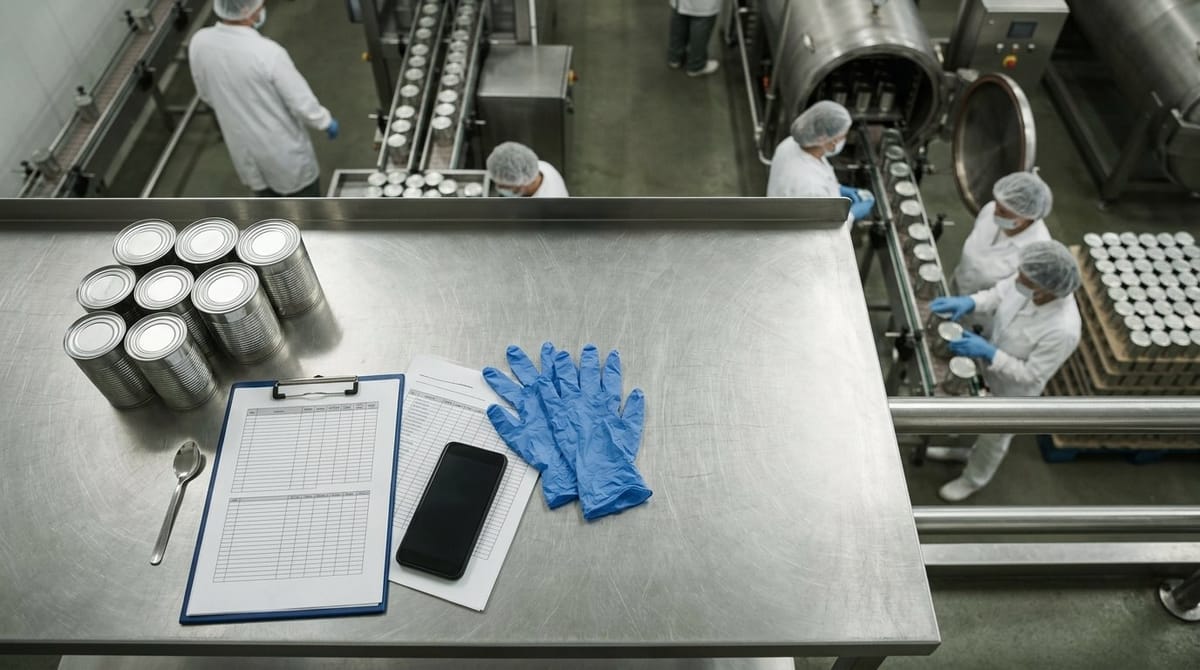
Quality Software for the Canning Industry
The canning industry operates under constant pressure: short campaigns, huge volumes, and products whose safety depends on critical processes that allow zero errors. Having quality software for the canning industry is no longer a competitive edge — it's an operational necessity for any company that wants to guarantee product safety, meet current regulations, and keep the line running efficiently. In this article we explain why paper falls short and what a digital solution genuinely built for the sector needs to deliver.
The quality-critical points unique to a cannery: sterilization, seal integrity and shelf life
A cannery isn't a generic food factory. Its processes have characteristics that set it apart and that massively raise the microbiological risk if control fails. The three critical pillars are sterilization, seal integrity and shelf life.
The sterilization process — whether by autoclave, pasteurization or UHT treatment — determines whether the product will stay safe for its entire commercial life. An insufficient F₀ value can leave viable Clostridium botulinum spores, with extremely serious consequences for the consumer. Regulation (EC) No 2073/2005 on microbiological criteria for foodstuffs (Regulation [EC] 2073/2005, 2005) sets the limits that must be met, requiring every heat-treatment cycle to be systematically logged and verified.
Seal integrity is the second major control point. A defective seam on a can, or an improper seal on a flexible pack, undoes all the prior sterilization work: the product recontaminates and shelf life collapses. That's why double-seam, pressure and leak-tightness checks need to run at a very high frequency throughout the campaign.
Finally, shelf-life validation closes the loop. Canned products are defined precisely by their durability, and any deviation in the process chain can shorten it unpredictably. Properly managing these three vectors requires full batch traceability and reliable records from raw material receiving through to finished product dispatch.
Why paper-based control can't keep up with a cannery's campaign batches
During the tomato, asparagus, pepper or tuna campaign, a cannery can pack tens of thousands of units within a few hours. In that context, paper has three structural problems that put the operation at risk.
The first is speed: when an operator has to fill out a paper form while running the line, records pile up, fall behind, or — worst case — get filled in from memory at the end of the shift. That turns the record into a fiction that doesn't reflect what actually happened in the process.
The second problem is fragmentation. Autoclave temperature data, seam controls, pH tests and issue records end up in different folders, in different departments, managed by different people. Cross-referencing that information to make a fast decision — blocking a batch, expanding sampling, releasing a shipment — becomes hours of work the campaign can't wait for.
The third is reactive traceability. With paper, traceability only exists in hindsight: if a problem shows up in the market, you have to manually dig through hundreds of sheets to scope the affected batch. With quality software, that same exercise takes seconds.
Quality software for canning: HACCP, sterilization control, batch traceability and line issues
Effective canning quality software needs to cover, in an integrated way, the four pillars the sector's quality management system rests on.
Digital HACCP built for the sector. The HACCP system — Hazard Analysis and Critical Control Points — is the backbone of food safety management, as required by Regulation (EC) No 852/2004 on the hygiene of foodstuffs (Regulation [EC] 852/2004, 2004). At a cannery, the CCPs include heat treatment, container sealing and, depending on the product, pH or water activity control. The software should let you configure these points, define critical limits, log measurements in real time, and generate automatic alerts when a limit is exceeded, without relying on an operator remembering to flag it.
Integrated sterilization control. The solution should be able to capture autoclave data — either through direct sensor integration or operator entry from a mobile device or in-line tablet — and automatically link it to the batch in progress. Any deviation in the time-temperature profile should be logged as an issue, automatically linked to the affected batch, and trigger the corresponding management protocol.
Full batch traceability. From the raw material — variety, supplier, receiving date — through to the finished product and its shipping destination, including the batches of containers, lids and additives used. This bidirectional traceability is essential for responding within minutes to a food safety alert or an inspection.
Line issue management. When a defect is detected on the production line — an out-of-spec seam, an abnormal pH, a damaged container — the system should let you open the issue right from the workstation, block the affected batch if needed, assign owners, and track it through to closure. No paper, no phone calls, no lost information.
How Solved keeps pace with a cannery's campaign without slowing down packing
Solved is quality software built for the food industry, and its rollout at canneries answers the real challenges we've just described. Solved's philosophy starts from a clear premise: the tool should adapt to the process, not the other way around.
During the campaign, time is the scarcest resource. That's why Solved lets line operators log controls from mobile devices or rugged tablets right at the workstation, with forms optimized to be completed in seconds. No trip to the office, no waiting for the end of the shift: data enters the system the moment it's generated.
Sterilization quality control at canneries is managed from a centralized dashboard where the quality manager sees the real-time status of every active autoclave and batch. If a sterilization curve shows an anomaly, the alert reaches the responsible person immediately, who can decide to hold the batch before it reaches the shipping warehouse. That avoids the cost — financial and reputational — of a market recall.
Batch traceability in Solved is bidirectional and covers the whole chain: from the field or the supplier through to the end customer. At a cannery running multiple lines in parallel with different references, that means you can scope exactly which batches were affected by a specific deviation within seconds, with no manual digging through archive folders.
Solved also integrates with HACCP documentation, letting you keep the records regulations require up to date without duplicating work. Audit reports are generated automatically from the data entered during production, drastically cutting the time needed to prepare for inspections and certifications.
If you want to dig deeper into the sector's specific challenges, check out our article on quality control in canning: challenges and digital solutions. And if your company also works with meat products, see how we approach that sector in our article on quality software for the meat industry.
In short, digitizing quality at a cannery isn't a project for the future — it's the only way to stay in control when the campaign is in full swing, batches keep coming without a pause, and there's zero margin for error. Solved is built to support you through that challenge.
References
- Regulation (EC) No 852/2004 of the European Parliament and of the Council of 29 April 2004 on the hygiene of foodstuffs. (2004). https://eur-lex.europa.eu/eli/reg/2004/852/oj?locale=es
- Commission Regulation (EC) No 2073/2005 of 15 November 2005 on microbiological criteria for foodstuffs. (2005). https://eur-lex.europa.eu/eli/reg/2005/2073/oj?locale=es