Quality Software for the Meat Industry
Quality Software for the Meat Industry
Managing quality at a meat plant is one of the most demanding tasks in the food sector. Production volumes, line speed and the perishable nature of the product mean any failure has immediate consequences for consumer safety and company reputation. Having quality software for the meat industry is no longer a competitive edge — it's an operational necessity for any slaughterhouse, cut-up room or processed meat plant that wants to meet current regulations while gaining efficiency. In this article we cover the specific risks you need to control, why paper records aren't enough, and what a digital solution genuinely built for this sector should include.
The specific quality risks in the meat industry: temperature, batch traceability and cross-contact allergens
Meat and meat products rank among the foods with the highest microbiological risk. Pathogens like Salmonella, Listeria monocytogenes or VTEC E. coli can multiply quickly if the cold chain breaks, even for just a few minutes. That's why temperature control in cold storage rooms, freezing tunnels and during transport is absolutely critical. A one-off manual reading doesn't provide the continuous traceability that genuinely effective quality management at a slaughterhouse requires.
On top of that is batch traceability. At a meat plant, a single animal can produce hundreds of different references that get mixed with batches from other animals throughout the process. Identifying in real time which raw material batch corresponds to which finished product — and being able to reconstruct that chain in the event of an alert — is both a regulatory obligation and an essential safeguard. As set out in Regulation (EC) No 178/2002 on general food law (Regulation [EC] 178/2002, 2002), food business operators must be able to identify anyone who has supplied them with food and any business they've supplied their products to.
Finally, cross-contact allergens are a growing risk in processed meat products. Using spices, dairy proteins, gluten or nuts in marinades and cured meats requires strict cleaning and segregation controls. An error in allergen declaration can trigger a market recall with a heavy financial and reputational cost.
Why paper falls short in cut-up rooms and cold storage
Paper records have been the standard in meat quality control for decades. But they carry limitations that become unsustainable as regulatory requirements and operational complexity grow. In a fast-paced cut-up room, an operator has very little time to stop their task and fill out a form accurately. The result is incomplete records, illegible data, or entries made after the fact that lose their value as evidence.
In cold storage rooms, the problem is even more obvious. Manual temperature readings are taken at set points — usually once or twice a day — leaving wide windows of time with no coverage. If a cold room's temperature spikes at three in the morning, nobody will know until the next day's check. By then, the damage may already be irreversible.
Paper also makes it hard to cross-reference data quickly. Matching a cold room's temperature record against the product batch it held at that moment, or against an issue logged by the shift supervisor, takes hours of work and manual digging through binders. In an audit or a health alert, that's time you simply don't have. Digitizing quality in the meat industry isn't just about modernizing — it's about reliability and emergency response.
Quality software for the meat industry: what a solution for this sector needs to cover
Not every quality management software is built for the reality of a meat plant. A quality manager evaluating digital solutions should make sure the tool covers, at minimum, the following functional blocks:
Digital HACCP: The system should let you create and manage Hazard Analysis and Critical Control Point plans entirely digitally, including critical limits, control frequencies, corrective actions and the documentary evidence tied to each point. As set out in Regulation (EC) 852/2004 on the hygiene of foodstuffs (Regulation [EC] 852/2004, 2004), food business operators must establish, implement and maintain a permanent procedure based on HACCP principles. Having this system in digital form makes it far easier to demonstrate compliance during inspections and certification audits.
Batch traceability: The solution should log batch movements at every stage of the process, from raw material receiving through to finished product dispatch. In the event of an alert, the software should let you locate every affected product and its delivery destinations within minutes.
Issue management: Any deviation detected — an out-of-range temperature, a supplier with incomplete documentation, a non-compliant test result — needs to be logged, assigned to an owner, and managed through to closure with evidence of the corrective action taken. Without this capability, control data has no real use for continuous improvement.
Internal and supplier audits: The software should include modules for planning, running and documenting audits, generating exportable reports that can be shared with customers, certification bodies or competent authorities. A good quality control software for the food industry brings all of these functions together in a single platform, avoiding scattered information across multiple tools.
Real-time alerts: For temperature control and other critical parameters, the tool should be able to generate automatic alerts that reach the quality or production manager the moment a deviation is detected, not hours later.
How Solved fits a meat plant's workflow without months of rollout
One of the biggest barriers to digitizing quality in the meat industry is the fear of a long, expensive rollout that disrupts plant operations. Solved was built specifically for the food sector, with a flexible architecture that lets you configure the system around each company's actual workflows, without custom development or lengthy consulting projects.
The Solved team works alongside quality managers from day one, bringing existing HACCP plans into the digital environment, configuring control points to match the plant's layout, and training the team to use the tool. The result is an agile rollout that, in most cases, gets you operational within a few weeks.
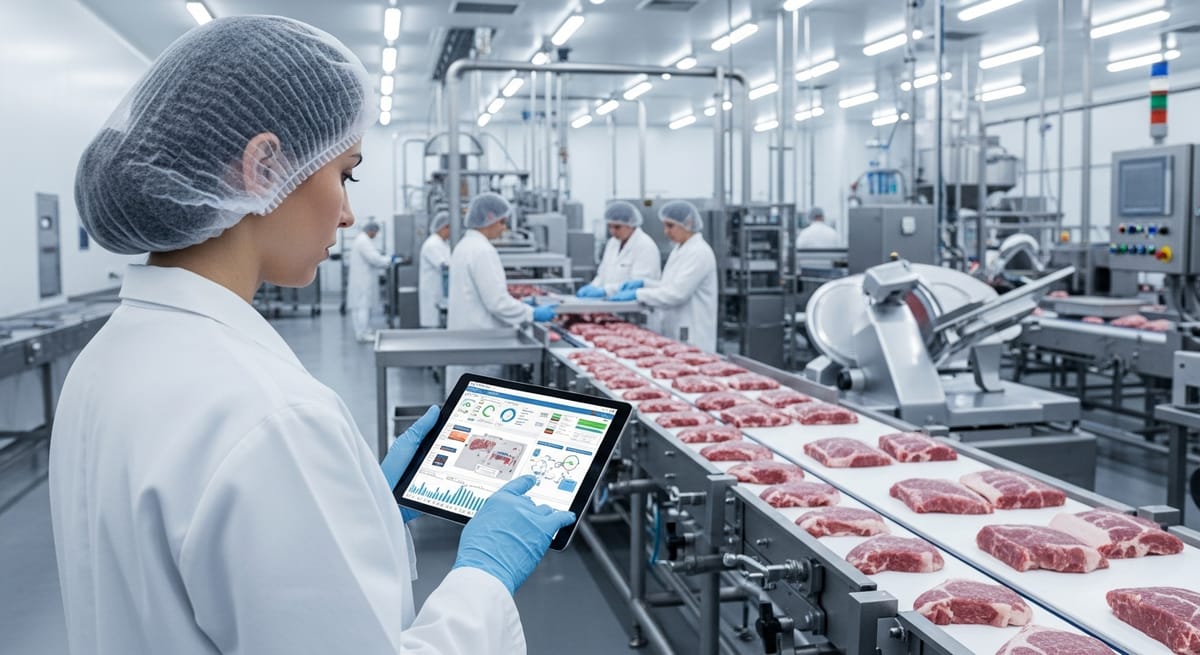
Solved is also built to be used right at the workstation. Operators can log data from tablets or mobile devices directly on the production line or in the cold room, eliminating paper without adding complexity. The quality manager gets a centralized dashboard where they can view the status of every control point, open issues and historical records with a single click.
If you want to see how Solved can adapt to your meat plant's specific challenges, our team is available to show you the solution in a personalized demo. Digitizing quality at your company is simpler than you think, and the benefits in traceability, regulatory compliance and operational efficiency show from day one.
References
- Regulation (EC) No 178/2002 of the European Parliament and of the Council of 28 January 2002 laying down the general principles and requirements of food law. (2002). https://eur-lex.europa.eu/eli/reg/2002/178/oj?locale=es
- Regulation (EC) No 852/2004 of the European Parliament and of the Council of 29 April 2004 on the hygiene of foodstuffs. (2004). https://eur-lex.europa.eu/eli/reg/2004/852/oj?locale=es