Quality Control Software for the Food Industry
Quality Control Software for the Food Industry
Managing quality at a food production plant isn't a task you can improvise or hand off to generic tools. Quality control software for the food industry has evolved into a key asset for any quality manager who wants to guarantee product safety, meet current regulations and gain operational efficiency at the same time. In this article we explain what a truly specialized solution should offer you, how it differs from a conventional ERP, and how you can roll it out at your factory in under 30 days.
Why the food industry needs dedicated quality software
The food industry operates under a demanding, constantly evolving regulatory framework. From the general principles of European food law to the microbiological criteria that apply to each product category, companies must be able to demonstrate at all times that their processes are under control. Any deviation can trigger a food safety alert, a product recall or, in the worst case, irreparable damage to brand reputation.
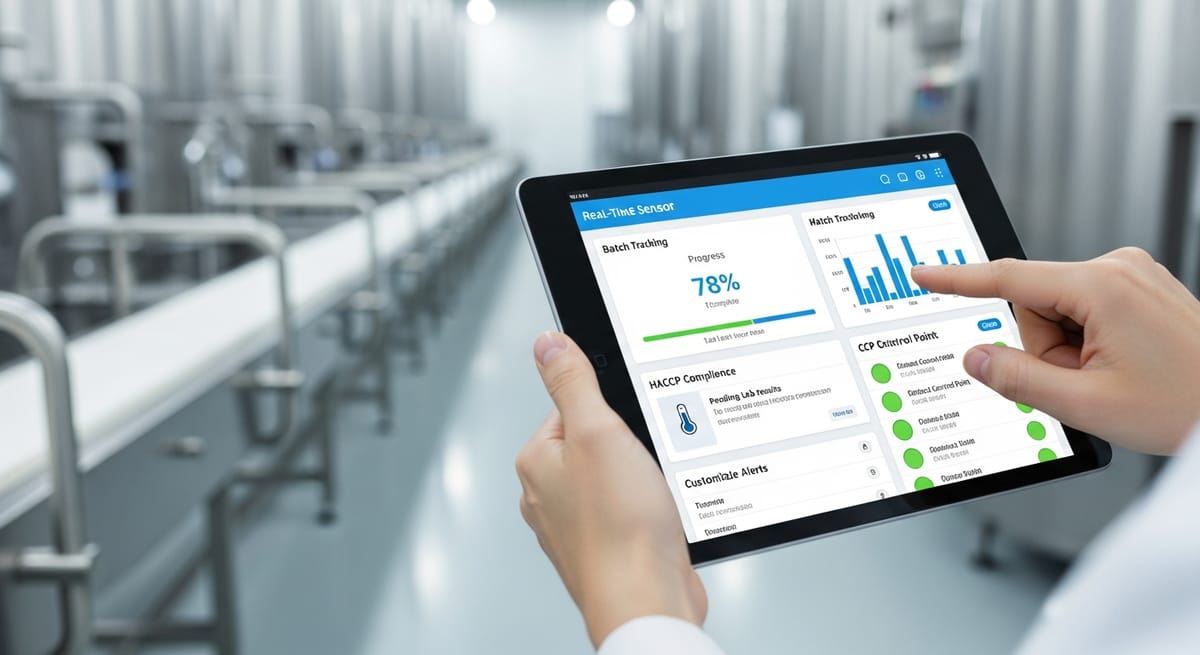
Software built exclusively for food quality management brings all these requirements together natively: batch-to-batch traceability, digitized HACCP plans, non-conformity records, supplier management, allergen control and automatic alerts for critical parameter deviations. All of it inside an interface designed so plant teams can log data in real time, without friction and without relying on spreadsheets or paper.
What features food quality software must have
Not every digital platform covers the same needs. When evaluating a solution, these are the modules it can't do without:
Digital HACCP system management. The software must allow Hazard Analysis and Critical Control Point plans to be created and maintained, checks at every CCP to be logged in real time, and the documentary evidence any audit requires to be generated automatically. As set out in Regulation (EC) No 852/2004 on the hygiene of foodstuffs (Regulation [EC] 852/2004, 2004), food business operators are required to put in place, implement and maintain a procedure based on HACCP principles. Having this digitized not only makes compliance easier — it significantly cuts audit preparation time.
Full forward and backward traceability. The ability to trace any ingredient or finished product across the entire supply chain is a legal requirement, but it's also a competitive advantage. A good system should be able to locate every affected batch in seconds in the event of a potential alert and quickly launch a recall or hold process.
Non-conformity and corrective action control. Logging, classifying and tracking detected deviations, together with managing corrective and preventive actions (CAPA), is essential for continuous improvement. The software should support the full cycle: detection, root cause analysis, action plan, verification and closure.
Supplier management and approval. Centralizing each supplier's documentation — certificates, test results, approval questionnaires — and automating expiry alerts keeps an expired certificate from turning into an audit finding.
Real-time indicators and dashboard. Quality managers need immediate visibility into the state of the system. A dashboard with the key KPIs — non-conformity rate, corrective action effectiveness, HACCP control compliance — enables informed decisions without waiting for month-end closes.
You can explore all these capabilities in detail on our features page.
Differences between a generic ERP and specialized software
A common question among quality managers is whether the quality module already included in their corporate ERP is enough. The short answer is that, in most cases, it isn't. These are the most relevant differences:
Functional depth vs. generalist breadth. An ERP is designed to cover finance, purchasing, logistics and production across any sector. Its quality module tends to be shallow and requires costly configuration to adapt to the food industry's specific requirements. Specialized software, by contrast, is built with those requirements already baked in.
Usability on the floor. Operators and quality technicians need to log data quickly and without errors, often from mobile devices or tablets right at the point of production. Generic ERP interfaces are optimized for office users, not the factory floor. Food-industry software designs its workflows around who will actually use them and under what conditions.
Automatic regulatory updates. Food legislation keeps evolving: new microbiological criteria, labeling changes, updates to standards like BRCGS Global Standards (BRCGS, n.d.) or IFS. A specialized vendor rolls these changes into the product continuously, while on a generic ERP each regulatory update can mean an additional consulting project.
Rollout time and cost. Precisely because specialized software comes preconfigured with the structures, forms and workflows native to the food industry, the time needed to get it running is significantly shorter. A generic ERP can require months of configuration and custom development to reach the same functional level.
How to roll it out at your plant in under 30 days
One of the biggest barriers to digitizing quality is the perception that a project like this is long, expensive and disruptive to daily operations. With the right methodology and a truly specialized solution, it's possible to have the system up and running in under a month. Here's how we do it at Solved:
Week 1 – Analysis and initial setup. In the first week we run a quick assessment of your current management system: what documents you use, how your HACCP plans are structured, what indicators you track. With that information, we configure the platform with your plant structure, production lines, product families and users.
Week 2 – Data migration and training. We import your existing master data — suppliers, raw materials, specifications — and train your quality and production teams. Training is hands-on, built around each user profile's real use cases.
Week 3 – Live production pilot. The team starts logging daily checks in the system under real conditions, supported by Solved's implementation team. Operational questions that come up day to day are identified and resolved.
Week 4 – Validation and full go-live. Workflows are validated, alert thresholds are fine-tuned and the first complete record cycle is closed. By the end of week four, the system is fully operational and the team is self-sufficient.
If you'd like to see how other companies in the sector have digitized their quality system with Solved, check out our success stories. And if you'd rather see it live, applied to your specific situation, request a personalized demo with no obligation.
Digitizing quality control in the food industry isn't an option reserved for big corporations. With the right tool and an agile rollout approach, any production plant can make the leap in a matter of weeks, strengthen its regulatory compliance and free its quality team from administrative burden so it can focus on what really matters: guaranteeing safe products.
References
- BRCGS. (n.d.). BRCGS Global Standards. https://www.brcgs.com/
- Regulation (EC) No 852/2004 of the European Parliament and of the Council of 29 April 2004 on the hygiene of foodstuffs. (2004). https://eur-lex.europa.eu/eli/reg/2004/852/oj?locale=en