Critical Control Point (CCP): A Practical Guide
Critical Control Point (CCP): A Practical Guide
If you manage quality at a food business, the concept of a critical control point is, without a doubt, one of the pillars your food safety system rests on. A poorly identified or poorly monitored CCP can translate into an unsafe product, a serious non-conformity during an audit, or, in the worst case, a public health issue. This practical guide explains exactly what a CCP is, how to identify one, what elements you must always keep under control, and how to digitize its management to gain agility and traceability.
What a critical control point is, and how it differs from a prerequisite
A critical control point is a phase, step or process in the production cycle where it's possible to apply a control measure that is essential to prevent, eliminate or reduce to an acceptable level a significant food safety hazard. The key word is "critical": not every point in the process deserves this category — only those where a loss of control would mean a real, unacceptable risk to the consumer.
The most common confusion among quality teams is mixing up CCPs with prerequisites or prerequisite programs (PRPs). Prerequisites are the baseline conditions that guarantee a hygienic working environment: cleaning and disinfection, pest control, staff training, facility maintenance, water management, and so on. Without solid prerequisites, the HACCP system can't function properly — but prerequisites don't control product-specific hazards; they work generically. A CCP, on the other hand, is tied to a specific hazard (biological, chemical or physical) identified in the hazard analysis, and its control is measurable, verifiable and documented individually.
Put another way: if a control failure affects the general production environment, you're probably looking at a prerequisite; if the failure could directly result in a food that's dangerous for the consumer, you're looking at a CCP. This distinction is essential both for keeping the system agile and for passing a HACCP plan audit.
How to identify a CCP with the Codex decision tree
The most widely used tool for determining whether a step is a CCP is the decision tree proposed by the Codex Alimentarius (Codex Alimentarius, n.d.). This decision tree is a logical sequence of questions the food safety team must answer for each hazard identified at each process step. The questions revolve around four key areas:
- Q1: Are control measures in place for the identified hazard? If the answer is no, you need to ask whether control is necessary for safety. If it is, the process or product must be modified before continuing.
- Q2: Is the step specifically designed to eliminate or reduce the hazard to an acceptable level? A heat treatment that destroys pathogens is the most classic example of a "yes."
- Q3: Could contamination with the identified hazard occur in excess of acceptable levels, or could it increase to unacceptable levels? This question assesses whether the step is a point where the hazard could build up or enter.
- Q4: Will a later step eliminate the hazard or reduce it to an acceptable level? If that later step exists and is effective enough, the current step is not a CCP.
The decision tree must be applied rigorously, backed by data, and with input from the whole multidisciplinary team: production, maintenance, quality and, when needed, outside experts. A common mistake is applying it mechanically without first carrying out a thorough hazard analysis. Without a solid analysis, the decision tree loses all its value.
It's also important to review established CCPs periodically. Any change to the process, ingredients, machinery or environment can alter the hazard map and, as a result, the validity of the CCPs already identified.
Critical limits, monitoring and corrective actions: the three pillars of every CCP
Once a critical control point is identified, the work has only just begun. Every CCP must be backed by three inseparable elements that, together, ensure control is real and demonstrable.
Critical limits. These are the maximum or minimum values that must be met to ensure the hazard stays under control. They can be physical (temperature, time), chemical (pH, salt concentration) or microbiological in nature, although real-time measurement is more complex in the latter case, as set out in Regulation (EC) 2073/2005 on microbiological criteria for foodstuffs (Regulation [EC] 2073/2005, 2005). Critical limits must be scientifically validated; setting them by habit or gut feeling isn't enough. They should be clearly distinguished from so-called operational limits, which are more conservative values used as an early warning signal before the critical limit is reached.
Monitoring. Monitoring defines what is measured, how often, with what instrument, and who is responsible for taking the measurement. An effective monitoring system must be able to detect any loss of control in time to act before the product reaches the consumer. Monitoring frequency should be proportional to risk: the greater the process variability or the severity of the hazard, the more frequent the checks should be.
Corrective actions. When monitoring detects that a critical limit has been exceeded, the predefined corrective actions must be triggered immediately. These actions have two goals: first, to bring the process back under control; second, to manage the affected product during the deviation (quarantine, destruction, reprocessing, etc.). Corrective actions must be documented and assigned to specific people. They can't be left to improvisation in the heat of the moment.
How to log CCP monitoring paper-free and stay audit-ready
Documentation is the backbone of any HACCP system. Without records, there's no evidence; and without evidence, there's no demonstrable control. Historically, CCP monitoring records have been kept on paper, which creates recurring problems: lost sheets, illegible data, difficulty consolidating information across shifts or lines, and long search times when an audit comes around.
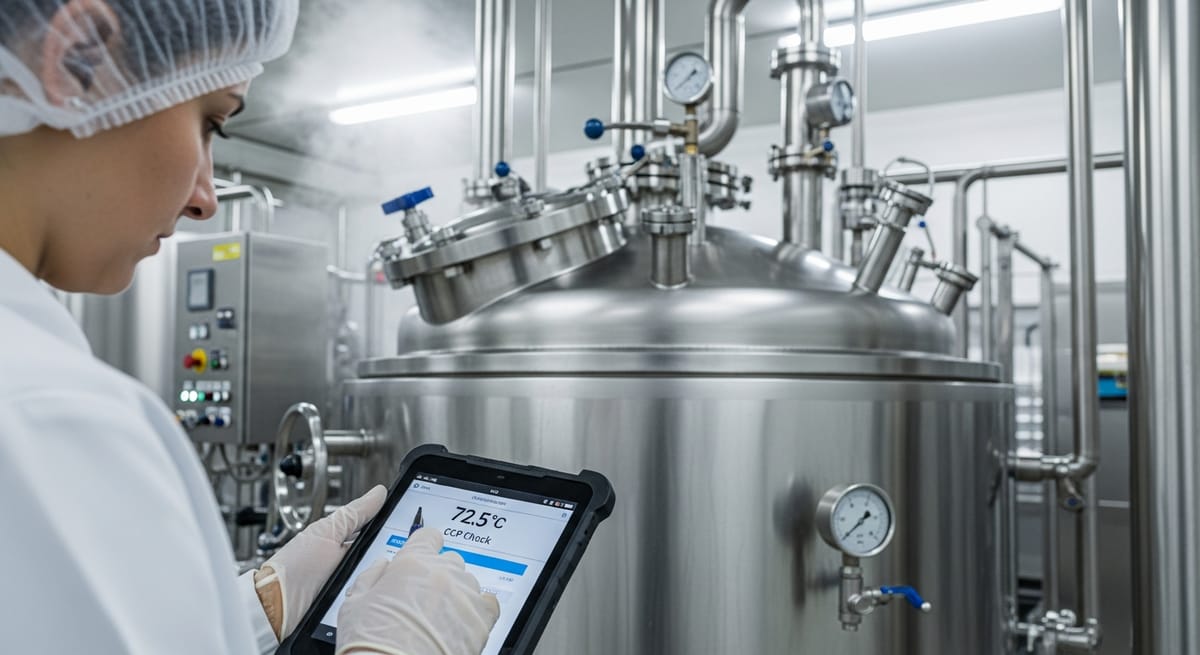
Digitizing CCP records solves all of these problems at the root. With a platform like Solved, operators log monitoring data directly from mobile devices or tablets on the plant floor, at the exact moment they take the measurement. The system generates automatic alerts when a value approaches or exceeds the critical limit, and there's an immediate record of the incident, the corrective actions taken, and who carried them out.
From an audit standpoint, the benefit is twofold. First, the auditor can access all historical records in real time, filtered by date, line, shift or CCP type, without digging through physical folders. Second, traceability is guaranteed end to end: every record is linked to the batch, the operator and the exact moment of measurement, removing any doubt about the accuracy of the data.
Digitization also makes trend analysis easier. If a CCP shows recurring deviations even while staying within the critical limit, the system can detect that pattern and alert the quality team before a real problem occurs. This turns CCP management from reactive into truly preventive — which is, in the end, the whole spirit of the HACCP system.
Implementing a digital CCP management system doesn't require huge investments or endless rollout projects. What matters is choosing a tool built specifically for the food industry, one that understands HACCP logic and lets you adapt forms to each company's real processes. If you want to learn more about structuring your HACCP plan from start to finish, check out our guide on how to build a HACCP plan step by step without errors.
References
- Codex Alimentarius. (n.d.). Codex Alimentarius (FAO/WHO). https://www.fao.org/fao-who-codexalimentarius/
- Commission Regulation (EC) No 2073/2005 of 15 November 2005 on microbiological criteria for foodstuffs. (2005). https://eur-lex.europa.eu/eli/reg/2005/2073/oj?locale=es