Cleaning and disinfection plan: how to build one
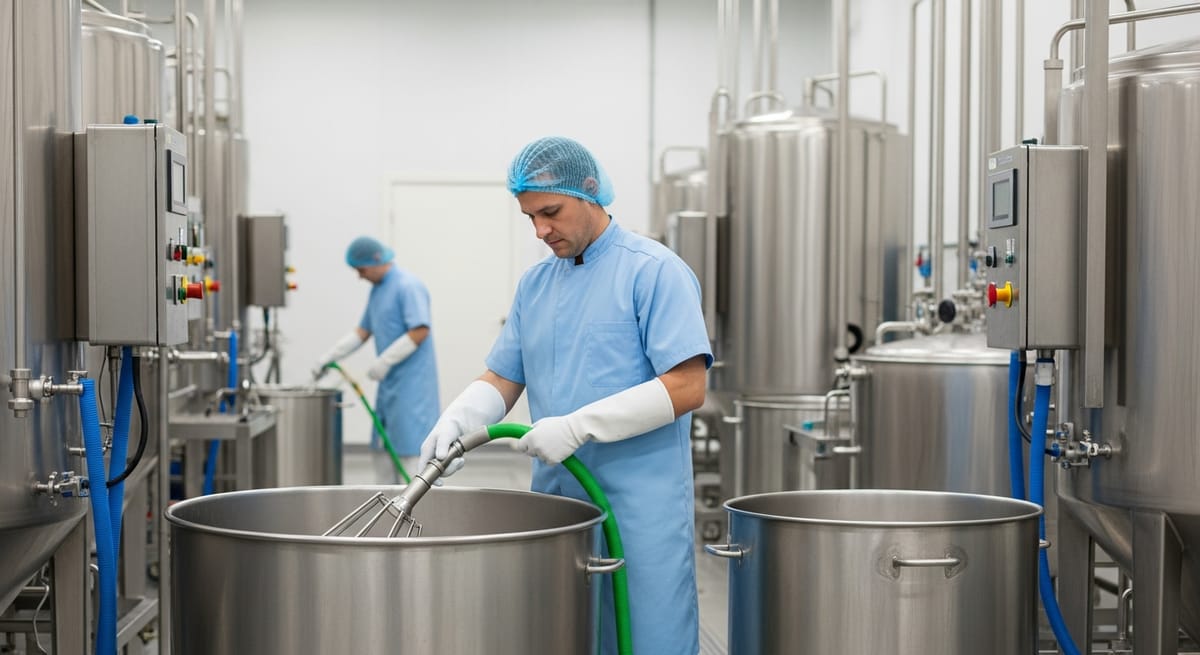
Cleaning and disinfection plan: the key to food safety
Keeping facilities in optimal hygienic condition isn't optional — it's a legal and ethical obligation for any company in the sector. The cleaning and disinfection plan is one of the fundamental pillars of any food safety management system. Without it, every other control loses its footing, because contamination can originate on surfaces, equipment or utensils that look clean at first glance. In this article we explain what it is, what it must include, how to verify it's working, and how Solved helps you manage it simply and with full traceability.
What a cleaning and disinfection plan (C&D) is
A cleaning and disinfection plan, often called a C&D plan, is a structured document that describes how, when, with what products and who is responsible for cleaning and disinfecting each area, piece of equipment and utensil in a food facility. Its purpose is to eliminate physical residue, pathogenic microorganisms and any contaminant that could compromise the safety of the finished product.
It's important to understand that cleaning and disinfecting are two distinct, complementary actions. Cleaning removes visible dirt, grease and organic residue, creating the conditions needed for disinfection to be effective afterward. Disinfection, in turn, reduces the microbial load to safe levels. Applying a disinfectant to a dirty surface is, quite simply, ineffective.
As set out in Regulation (EC) No 852/2004 on the hygiene of foodstuffs (Regulation [EC] 852/2004, 2004), food business operators must keep clean and, where appropriate, disinfected all utensils, apparatus and equipment that come into contact with food, as well as the surfaces and structures of their premises. Not having a documented, implemented C&D plan can therefore amount to a serious legal non-conformity.
In the context of the food industry, this plan is part of the prerequisite programs that the hazard analysis and critical control points (HACCP) system is built on. Without a solid hygienic foundation, every subsequent control measure loses its effectiveness.
What the cleaning and disinfection plan must cover, and how often
A complete, effective cleaning protocol must capture, at minimum, the following elements for each area or piece of equipment covered:
- Area or equipment being cleaned: a precise description of the zone or machinery (production line, cold room, conveyor belt, vats, etc.).
- Person responsible: the person or team in charge of carrying out the task.
- Frequency: how often it's carried out (after each production run, daily, weekly, monthly…).
- Method: detailed steps of the process, including the order of operations, water temperatures, product contact times and rinsing technique.
- Products used: commercial name, active ingredient, use concentration and safety data sheet for each detergent and disinfectant.
- Personal protective equipment (PPE): gloves, masks, goggles or other items needed to keep the operator safe.
- Precautions: notes on product compatibility, waiting times before resuming production, and waste management.
As for frequency, there's no single right answer: it depends on the type of food being handled, the associated microbiological risk, environmental conditions and applicable regulatory requirements. As a general rule, areas that come into direct contact with food (cutting tables, hoppers, internal piping) require more frequent, more intensive cleaning than auxiliary areas. Reviewing the plan itself periodically — at least once a year, or whenever the process changes — keeps it fit for purpose.
How to verify the effectiveness of the cleaning and disinfection plan in the food industry
Documenting the plan and carrying it out isn't enough: you also need to verify that C&D actions are actually working. This verification can be done through several methods, which are best combined to get a complete picture:
Visual inspection: visually checking surfaces, equipment and hard-to-reach corners is the quickest way to catch obvious failures. While it won't detect microbiological contamination, it's the first line of control.
ATP bioluminescence: ATP meters let you assess residual organic load on a surface in real time. A high reading in relative light units (RLU) points to organic matter and, therefore, insufficient cleaning. It's a fast, affordable tool that's very useful for routine verification.
Microbiological testing: environmental sampling (surface swabs) and lab analysis confirm how effective disinfection is against specific microorganisms. Regulation (EC) No 2073/2005 on microbiological criteria for foodstuffs (Regulation [EC] 2073/2005, 2005) provides the reference framework for interpreting these results in a food safety context.
Process indicators: disinfectant concentration, water temperature, contact time and other measurable parameters that confirm the process was carried out correctly.
The results of these checks need to be recorded, reviewed regularly, and turned into corrective actions whenever a deviation is detected. A C&D plan that isn't continuously reviewed and improved stops being effective over time.
How to record and verify cleaning with Solved
Managing a cleaning and disinfection plan on paper or across scattered spreadsheets creates inefficiencies, increases the risk of losing information, and makes audits harder. Solved, the quality software for the food industry, centralizes the entire management of the C&D plan in a single digital platform that's intuitive and accessible from any device.
With Solved you can define the cleaning protocol for each area or piece of equipment — method, frequency, person responsible and products — directly in the system. Operators get automatic reminders when a task is due and log its completion on the spot, eliminating forgotten tasks and delays. Every cleaning record is stored with date, time and user, building a complete, auditable history.
Verification is also managed within the platform: you can schedule ATP checks, visual inspections or microbiological sampling, assign them to a person responsible, and link the results back to the plan. If a deviation is detected, Solved lets you open a corrective action immediately and link it to the corresponding cleaning record, keeping full traceability of the issue.
During a certification audit or an official inspection, all of this information is available in seconds — filtered by date, area or person responsible. There's no more digging through folders or reconstructing records after the fact. The quality team saves time, reduces stress, and proves the company's commitment to food safety with real data.
If you want to see how Solved can transform the way you manage your cleaning and disinfection plan, request a free demo and see for yourself the difference it makes to work with a tool built specifically for the needs of quality managers in the food industry.
References
- Regulation (EC) No 852/2004 of the European Parliament and of the Council of 29 April 2004 on the hygiene of foodstuffs. (2004). https://eur-lex.europa.eu/eli/reg/2004/852/oj?locale=es
- Regulation (EC) No 2073/2005 of the Commission of 15 November 2005 on microbiological criteria for foodstuffs. (2005). https://eur-lex.europa.eu/eli/reg/2005/2073/oj?locale=es