Stop Losing Quality Control Records
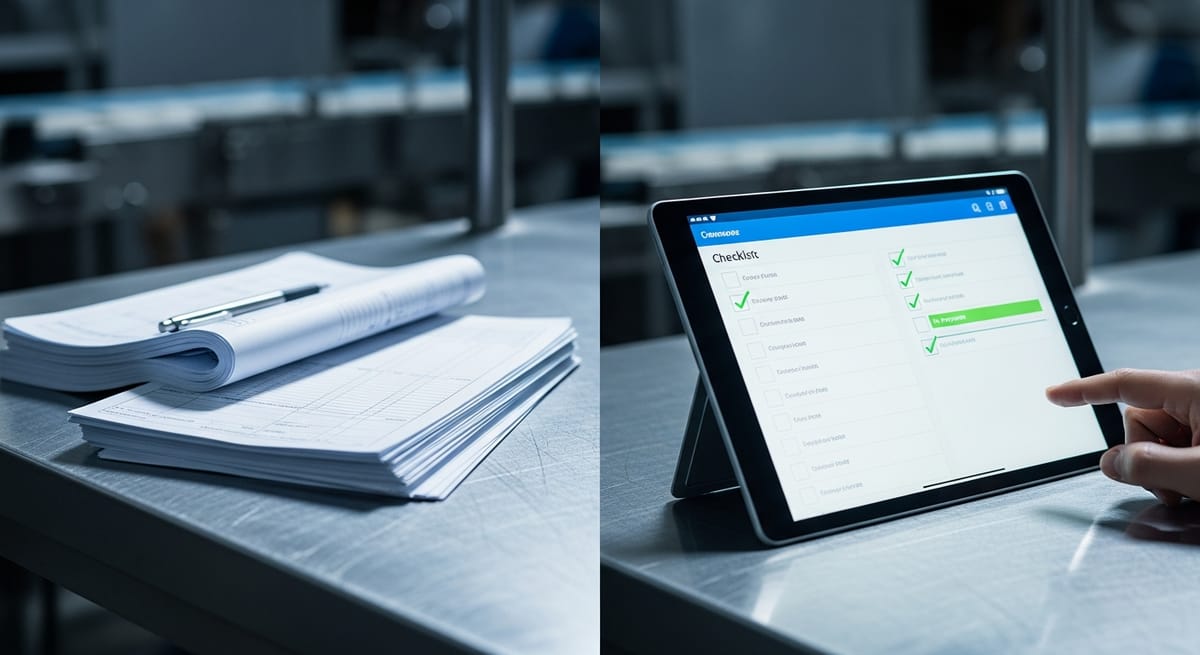
Stop losing quality control records
If you work in quality in the food industry, you know exactly what happens when an unannounced audit shows up: the team scrambles to find folders, digs through Excel sheets scattered across different computers, and tries to piece together information that should be accessible in seconds. Losing quality control records doesn't just create stress — it can compromise product traceability, expose the company to penalties and damage trust with customers and distributors. In this article we explain why it happens, what you stand to gain by digitizing your processes, and how to take the first step in an orderly way.
The problem with paper and Excel in quality control
For years, paper and spreadsheets have been the go-to tools for quality departments. They're accessible, familiar and, on the surface, good enough. But as data volume grows, reality looks different: badly filled-out forms, duplicate files, different versions of the same template circulating by email, and data that simply disappears because someone forgot to save the file.
Tracking issues in Excel is perhaps the clearest example. A spreadsheet can log an issue, but it won't flag you when it hasn't been closed, it doesn't build a reliable history, and it doesn't let you cross-reference data with the affected batch or the supplier involved. Every time there's a deviation, the quality manager has to investigate manually, with a real risk of missing something.
On top of that comes the human factor: entering data by hand is tedious and error-prone. A misplaced decimal, a wrong date or a blank field can turn a record into something useless right when it's needed most. And if the information is on paper, the problem multiplies: the document can get stained, torn, filed in the wrong place, or simply fail to turn up when needed.
As set out in Regulation (EC) No 178/2002 on general food law (Regulation [EC] 178/2002, 2002), food business operators are required to ensure the traceability of their products at every stage of production, processing and distribution. Meeting that requirement with just paper or Excel isn't impossible, but it's a path full of unnecessary risk.
Benefits of digitizing your quality records: traceability, stress-free audits and fewer errors
Moving to digital quality records isn't simply about swapping paper for a screen. It transforms how the quality department works, accesses information and responds to any issue.
The first benefit is real, real-time traceability. When a record is generated digitally and linked to a batch, a supplier or a production line, you can trace any issue in seconds. There's nothing to reconstruct: the information is already there, structured, accessible and ready to consult.
The second benefit has to do with audits. Preparing for an audit when all records are digitized is a completely different experience from working with paper. Instead of spending hours tracking down documents, the quality manager can generate automatic reports, filter by date, control type or product line, and present the information in an orderly way. Less stress, more confidence, and a more professional impression on the auditor.
The third benefit is fewer errors. Digital forms can include required fields, format validation and automatic alerts when a value falls outside the set range. This eliminates most transcription errors and ensures records are complete and consistent from the start.
Finally, digitization makes trend analysis possible. With structured data, you can spot patterns: are there more issues on a particular shift? Does one supplier generate more rejections? Are non-conformities concentrated on a specific line? This information is invaluable for making preventive decisions and continuously improving your quality system.
Which quality control records to digitize first
If you're just starting the quality digitization process, it can feel overwhelming to know where to begin. The key is to identify the records that have the biggest impact on traceability and issue response, and start there.
These are the records that typically cause the most problems when managed on paper or in Excel, and that benefit most from digitization:
- Raw material receiving records: temperatures, packaging condition, supplier documentation. These are the first line of control and need to be documented thoroughly.
- Process controls: cooking temperatures, pasteurization times, packaging parameters. Any deviation here can have serious consequences if it isn't caught and logged in time.
- Cleaning and disinfection records: required under Regulation (EC) No 852/2004 on the hygiene of foodstuffs (Regulation [EC] 852/2004, 2004), and especially prone to being left incomplete when managed on paper.
- Non-conformities and issues: the record of each deviation, its root cause, the corrective actions taken and the verified closure of each issue.
- Equipment calibration and maintenance: essential to ensure the checks you run are reliable.
You don't have to digitize everything at once. A gradual approach, starting with the most critical records, lets the team adapt without friction and makes results visible from the start.
How to do it with configurable templates in Solved
Solved is quality software built specifically for the food industry, designed so quality managers can digitize their processes without advanced technical knowledge or heavy investment in training.
One of the features quality teams value most is the configurable template system. With Solved you can build your own digital forms tailored exactly to the checks you already run: with the fields you need, the alert ranges you define, and the approval flow that fits your company. You don't have to adapt to a rigid structure — the platform adapts to how you work.
Solved also lets you manage issue tracking in a way that's radically different from Excel. Every issue is logged with its date, owner, affected batch and associated corrective actions. The system flags issues that stay open longer than expected and lets you generate closure reports with a single click.
Traceability is complete and bidirectional: from a raw material you can trace forward to the finished product, and from an issue you can trace back to the supplier, the batch or the production shift involved. All information is connected, accessible from any device, and protected against loss or unauthorized changes.
If you're still managing your quality control records on paper or in spreadsheets, now is the time to make the switch. The question isn't whether you can afford to digitize — it's whether you can afford not to.
References
- Regulation (EC) No 178/2002 of the European Parliament and of the Council of 28 January 2002 laying down the general principles and requirements of food law. (2002). https://eur-lex.europa.eu/eli/reg/2002/178/oj?locale=en
- Regulation (EC) No 852/2004 of the European Parliament and of the Council of 29 April 2004 on the hygiene of foodstuffs. (2004). https://eur-lex.europa.eu/eli/reg/2004/852/oj?locale=en