Issue Management Software: How to Choose the Best One
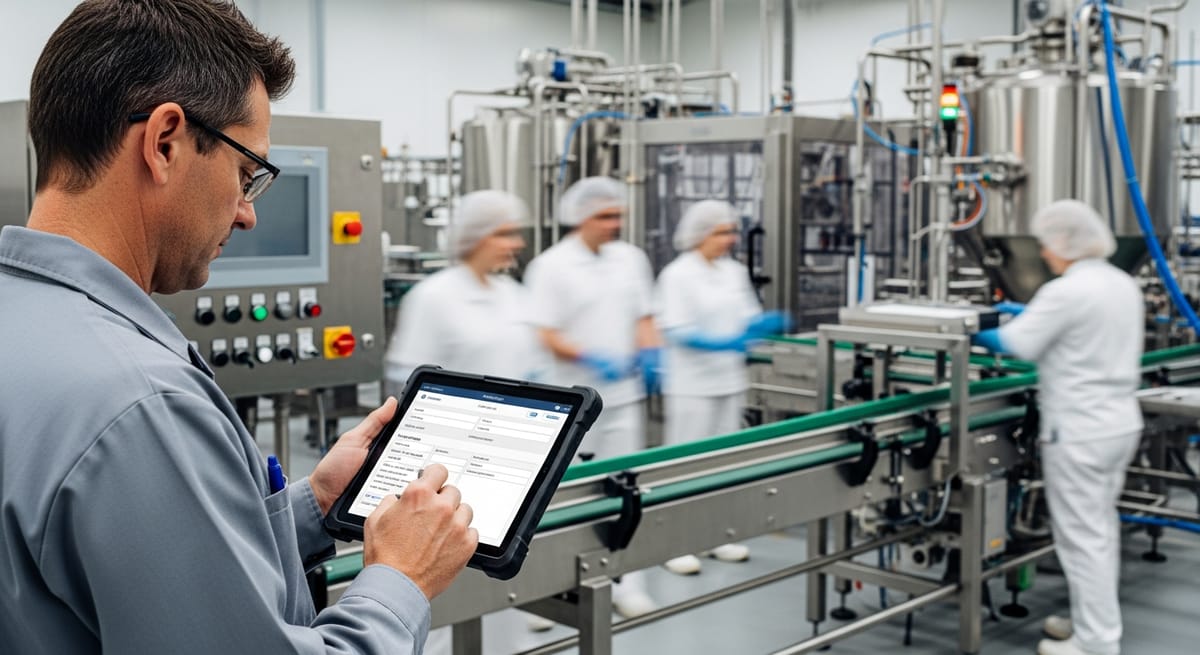
Issue management software: how to choose the best one for your food plant
When a problem happens on the production line — a temperature deviation, a foreign body found, a customer complaint — every minute counts. Having the right issue management software is the difference between resolving the problem in an organized, traceable, efficient way, or losing valuable information among WhatsApp chats and spreadsheets that never get updated. In this article, we explain what to look for in an issue management tool and why choosing the right system is a strategic decision for any quality manager.
What issue management software is and what it needs to solve in a food plant
Issue management software is a digital tool that lets you log, assign, track, and close any deviation or problem that occurs in a production process. In the food industry, these issues can range from an internal non-conformity to a customer complaint, and also cover equipment failures, deviations at critical control points, or supplier problems.
What sets a good issue management system apart in this sector is its ability to meet very specific requirements: full traceability for every issue, records with date, time, and the responsible user, links to affected batches or products, and a workflow that guarantees every case actually gets closed. All of this sits within the framework set by Regulation (EC) No 178/2002 on general food law (Regulation [EC] 178/2002, 2002), which requires operators to have systems in place to identify and manage anything that could affect food safety.
In practice, a good tool needs to solve three big challenges: making sure no issue gets lost or goes unattended, ensuring there's always a clear owner, and keeping the data available for audits, trend analysis, and continuous improvement.
Why Excel and WhatsApp fall short (no traceability, no closure)
Many food plants still manage their issues with tools that were never built for the job. Excel and WhatsApp are the most common. And while they might seem fine at first, as soon as the volume of issues grows or a certification audit arrives, the weaknesses become obvious.
The main problem with Excel is that it doesn't guarantee traceability. Anyone can edit a cell without leaving a trace, there's no reliable change history, and information ends up scattered across different versions of the same file. It also can't assign owners automatically or send alerts when an issue has been open too long.
WhatsApp, for its part, mixes day-to-day communication with issue logging. An important message gets buried among others, there's no way to confirm anyone has actually acted on it, and it's impossible to generate a structured report when the audit arrives. Food safety standards such as BRCGS Global Standards (BRCGS, n.d.) require documented, traceable evidence of how issues and non-conformities are managed — something no chat thread can demonstrate.
The end result of using these ill-suited tools is always the same: unresolved issues, unclear ownership, incomplete data, and real exposure to risk when you have to explain to an auditor or a customer what was done, when, and by whom.
Must-have features: logging, owner assignment, alerts, KPIs, and traceability
If you're evaluating which issue management system to implement at your plant, here are the features you can't do without:
Centralized, structured logging. Every issue must be recorded in one single place, with defined fields: issue type, affected area, product or batch, a detailed description, photo evidence where available, and the exact date and time it was opened. The more structured the record, the more useful the data will be for later analysis.
Automatic owner assignment. Every issue needs a clear owner. The system should let you assign the issue to the right person or department the moment it's logged, with an immediate notification so there's no delay in the response.
Alerts and automatic escalation. If an issue goes a set amount of time without a response or closure, the system should automatically alert the next level up. This escalation mechanism is essential to keep problems from staying open indefinitely.
Full process traceability. Every status change, every comment, every action taken, and who took it must be recorded. This traceability is what lets you prove to an auditor that the issue was handled correctly from start to finish.
KPIs and trend reports. Good issue tracking goes beyond solving one-off problems. The system should provide key indicators: number of issues by area or shift, average resolution time, recurring issues, percentage of on-time closures. This data is gold for continuous improvement.
Integration with non-conformities and corrective actions. Issues often turn into non-conformities and corrective action plans. The system should support this link so the workflow stays consistent, with no duplication or lost information between separate modules.
How Solved centralizes issues with unlimited users, as a complement to your ERP
Solved is the quality software built specifically for the food industry, and its issue management module is designed to address every challenge described above. Unlike generic solutions, Solved understands the reality of a food production plant: shifts, different areas, multiple issue categories, and the need to be audit-ready at any moment.
One of the features quality managers who already use Solved value most is that it works with unlimited users at no extra cost. That means operators, line supervisors, quality technicians, and management can each access the system with their own profile, log issues from any device, and check the status of any case in real time. There are no cost-driven adoption barriers, which makes it much easier for the whole organization to buy into a quality culture.
Another differentiator is that Solved works as a complement to the company's ERP, not a replacement for it. Many plants already run an enterprise system that controls production, inventory, or accounting. Solved integrates with it to enrich quality management without duplicating data or creating information silos. The result is a coherent digital ecosystem where information flows between systems and teams work with up-to-date data.
The workflow in Solved is simple but powerful: any user spots an issue, logs it in seconds using the structured form, the system automatically assigns the owner and sends a notification, actions taken get recorded, and the issue is closed with all the evidence documented. If the deadline is ever missed, automatic escalation makes sure no one is left without a response.
On top of that, Solved's dashboards let the quality manager see the status of every open issue in real time, spot recurring patterns, and present executive reports without having to build them by hand. Complete issue control, centralized, traceable, and ready for the next audit.
If you're looking for the best issue management software for your food plant, the key isn't just the feature list — it's whether the system fits your operational reality and grows with you. That's exactly what Solved is built for.
References
- BRCGS. (n.d.). BRCGS Global Standards. https://www.brcgs.com/
- Regulation (EC) No 178/2002 of the European Parliament and of the Council of 28 January 2002 laying down the general principles and requirements of food law. (2002). https://eur-lex.europa.eu/eli/reg/2002/178/oj?locale=es