Quality Software for the Beverage Industry
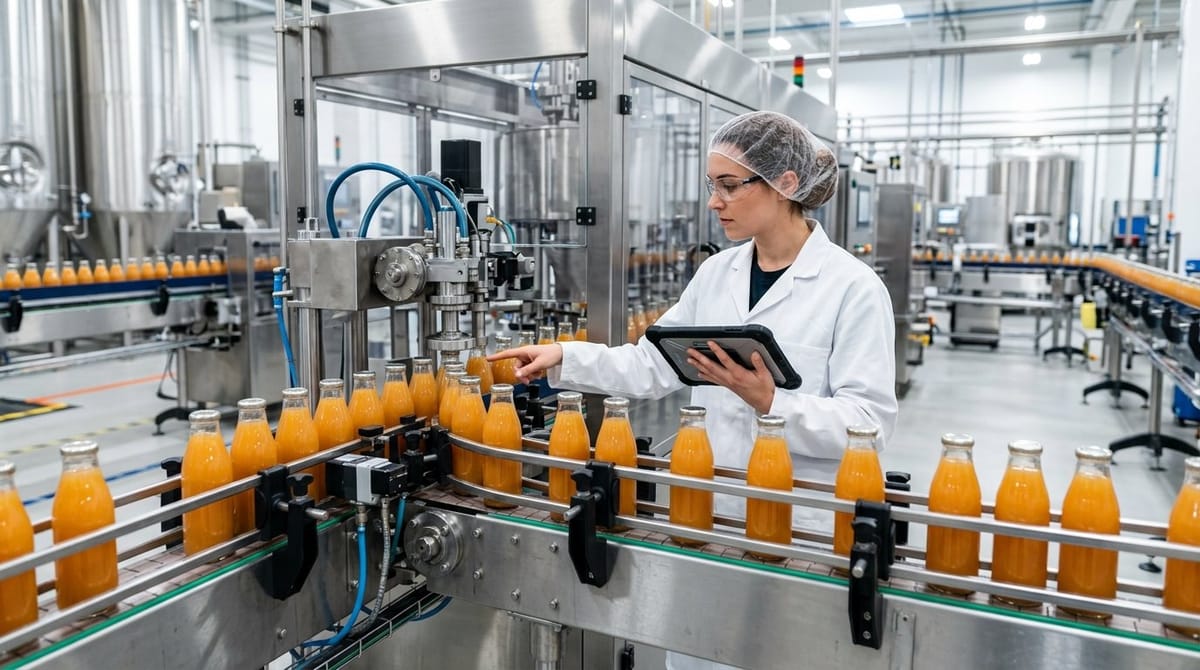
Quality Software for the Beverage Industry
The beverage industry operates under a regulatory and competitive pressure that few branches of the food sector experience with the same intensity. High-speed bottling lines, sensitive ingredients, water as a critical raw material, and major retail customers demanding internationally recognized certifications — the context says it all. Quality software for the beverage industry isn't a luxury reserved for big plants; it's the tool that lets quality managers stay in control without slowing production, pass audits, and make decisions based on real data instead of scattered spreadsheets. In this article we look at the sector's critical points, what the most relevant certifications ask for, and what capabilities a digital solution built specifically for beverages needs to have.
The quality-critical points unique to the beverage industry
Quality control software for beverages exists to answer a very specific need: the risk vectors in this sector differ from those in meat or dairy, and require equally specific controls. Three broad areas account for most of the non-conformities and food safety incidents.
Water and raw material control. Water isn't just another ingredient in sodas, beers, juices or functional drinks — it's the majority raw material and the main vehicle for chemical and microbiological contamination. pH, hardness, residual chlorine, conductivity and heavy metal parameters need to be logged at a frequency no manual system can reliably sustain. The same applies to concentrates, sweeteners, additives and flavorings, where batch traceability from supplier to finished product is essential for reacting quickly to any alert.
Line sanitation (CIP/SIP). Clean-in-place systems are the backbone of hygiene at a bottling plant. Every CIP cycle needs to be logged: temperature, time, chemical concentration and result verification. When this is recorded on paper, transcription errors and documentation gaps are inevitable. Quality software integrated with the equipment can capture this data automatically and generate alerts if a parameter falls out of range before the line resumes production.
Microbiological control. Yeasts, molds and bacteria such as Alicyclobacillus in juices, or spore-forming microorganisms in low-acid beverages, are real threats. Regulation (EC) No 2073/2005 on microbiological criteria for foodstuffs (Regulation [EC] 2073/2005, 2005) sets the legal limits, but proactively managing microbiological risk requires a platform that lets you log test results, compare them against specifications, and automatically escalate issues to the responsible team.
Why GFSI and ISO 22000 audits carry so much weight in this sector, and what evidence they demand
Major distribution operators and top-tier retailers won't accept beverage suppliers without a recognized certification. Standards like BRCGS, IFS Food, FSSC 22000 or SQF are backed by the Global Food Safety Initiative (GFSI) (GFSI, n.d.), the global reference for mutual recognition of these schemes. You can learn more about what GFSI is and how to choose the right standard for your plant in our article on GFSI and certification standards.
What all of these certifications have in common is their demand for objective, systematic evidence. An auditor visiting a bottling plant doesn't just want to see written procedures — they want to verify that controls are actually carried out, that results are logged, that deviations are managed with documented corrective actions, and that the management system keeps improving. When all of that evidence lives on paper or in Excel files with no version control, the audit turns into a race against the clock to locate documents and consolidate data.
Quality management software for bottling plants fixes this problem at the root: it centralizes documentation, timestamps every control with a user attached, links non-conformities to their corrective actions, and generates audit-ready reports within minutes. The difference between passing a GFSI audit with an excellent score and having to redo it can come down precisely to the quality of your digital traceability.
What beverage quality software needs to cover, versus a generic food quality tool
There's a real difference between well-designed quality software for the beverage industry and a generic food quality solution that fits the sector poorly. Here are the capabilities you can't do without:
- Management of specific physicochemical parameters: pH, °Brix, titratable acidity, carbonation, turbidity, color and alcohol content, with configurable specification tables by reference and label format.
- Integration with lab and line equipment: connection to in-line meters, multi-parameter analyzers and LIMS systems to avoid double data entry and reduce human error.
- CIP/SIP control: a dedicated module for logging and validating cleaning cycles, with automatic alerts on deviations and line blocking until release is confirmed.
- Bidirectional batch traceability: from the raw material supplier through to the finished product and its distribution, with the ability to simulate a market recall and scope its impact within minutes.
- Document management with version control: procedures, spec sheets, HACCP records and sampling plans always accessible and in their current version.
- Real-time dashboards: key quality indicators (KQIs) visible to the quality manager without manually consolidating data.
If you want to explore how these capabilities fit into a comprehensive platform for the food industry, check out our solution for the food industry, or read our article on quality control software for the food industry.
How to digitize without stopping the bottling line
The main pushback quality managers voice when digitization comes up is the fear of disrupting production. A plant bottling 20,000 containers an hour can't afford stoppages to roll out a new system. The good news is that well-planned digitization doesn't require stopping anything.
The most effective approach is a modular, phased rollout. In the first phase, documentation and control plans migrate to the software, so the quality team starts working digitally without touching production flows. In the second phase, lab control points and CIP records get integrated. Only in a third phase, once the team is comfortable with the tool, do you connect in-line equipment for automatic data capture.
Having a software provider that guides you through this process makes a real difference. An implementation team with beverage experience understands the logic of bottling lines, knows the sector's most common non-conformity types, and can configure the platform with templates and workflows tailored from day one. The result is a short learning curve and genuine adoption by operators and quality technicians alike.
In short, quality control in beverages has grown more complex in regulatory terms and in customer demands, but it also now has digital tools that make it possible to manage more efficiently, traceably and safely. Choosing software built specifically for the sector isn't just a technology decision — it's a strategic one that directly affects the plant's competitiveness and consumer trust in every bottle that leaves the line.
References
- Global Food Safety Initiative. (n.d.). Global Food Safety Initiative (GFSI). https://mygfsi.com/
- Commission Regulation (EC) No 2073/2005 of 15 November 2005 on microbiological criteria for foodstuffs. (2005). https://eur-lex.europa.eu/eli/reg/2005/2073/oj?locale=es