Quality Software for the Poultry Industry
Quality Software for the Poultry Industry
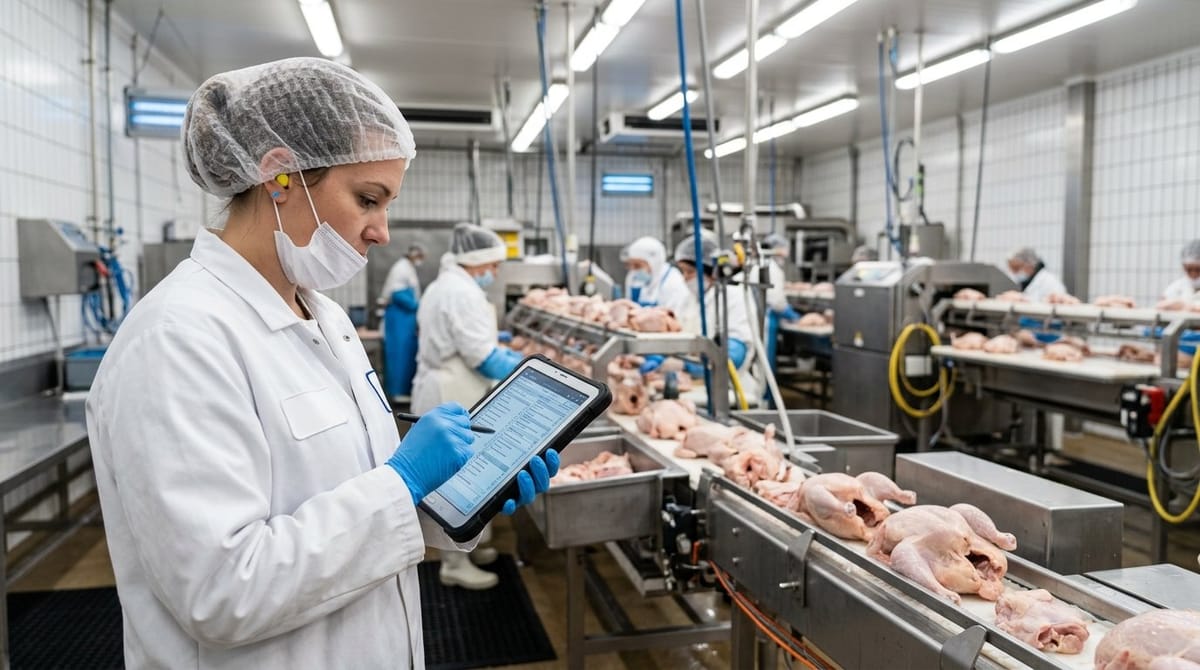
Quality software for the poultry industry has become an indispensable tool for any quality manager who wants real control over their processes, regulatory compliance, and audits that go smoothly. The poultry industry has technical and regulatory particularities that set it clearly apart from other meat sectors: very high slaughter line speeds, strict cold chains, demanding microbiological control, and batch traceability that has to work in real time. Trusting that responsibility to spreadsheets or generic ERP modules is, simply put, taking on an unnecessary risk.
The control points specific to the poultry industry: animal welfare, microbiological control and cold chain in cut-up
The poultry industry concentrates, in a small space and within a few hours, a number of control points that other sectors spread out over days. Animal welfare at live bird receiving is the first: ante-mortem inspection, logging of losses during transport, holding conditions and stunning. Any deviation here means not just a legal violation but an immediate reputational risk.
Next, microbiological control takes center stage. As set out in Regulation (EC) No 2073/2005 on microbiological criteria for foodstuffs (Regulation [EC] 2073/2005, 2005), there are specific food safety and process hygiene criteria for broiler carcasses, including limits for Salmonella and Campylobacter counts. Meeting these criteria requires a systematic sampling plan, agile management of test results, and the ability to link every result to the specific batch it belongs to.
Finally, the cold chain during cut-up is the third critical axis. Cuts must reach the required temperature within set times and stay in range until dispatch. Any break, even a brief one, can invalidate an entire batch or trigger an audit non-conformity. Quality software for the poultry sector needs to log, alert and document these deviations automatically, without relying on an operator remembering to write down the data.
Why temperature and batch traceability non-conformities are the most common in poultry audits
When you look at audit reports from poultry slaughterhouses and cut-up rooms, two categories of non-conformity show up again and again: those tied to temperature control and those tied to batch traceability. The reason isn't that quality teams lack competence — it's that line speed and the volume of data generated far outpace what any manual system can handle.
On a medium-volume poultry slaughter line, thousands of birds can be processed per hour. Each one generates data points that need to be logged and linked: carcass temperature, inspection result, delivery destination, source batch number. If this is recorded by hand or transcribed into a spreadsheet afterward, traceability breaks down in practice, even if it looks fine on paper.
Temperature non-conformities often arise not because equipment fails, but because logging isn't continuous, or because the alert comes too late, after the product has already left the control point. Specialized software connected to sensors, or integrated with cold room systems, catches the deviation the moment it happens, not hours later. That turns a potential product recall into a simple documented correction — exactly what the auditor wants to see.
As for traceability, the legal requirement is clear: as Regulation (EC) No 178/2002 laying down the general principles and requirements of food law (Regulation [EC] 178/2002, 2002) states, every food business operator must be able to identify anyone who has supplied them with food, and the businesses they've supplied their products to. In poultry practice, where a carcass batch can get mixed with another during cut-up or when making prepared products, maintaining that traceability requires a digital system that manages those relationships automatically.
What quality software built for slaughterhouses and cut-up rooms delivers over a generic ERP
This is the question we hear most from quality managers who've tried to adapt a corporate ERP to their specific needs. The answer is simple: an ERP is built to manage business resources, not to be the nervous system of a food quality plan.
Quality software built for the food industry — and specifically for poultry processing — needs to include, out of the box, capabilities that an ERP can only deliver through costly, never fully satisfying custom development. These include:
HACCP management adapted to the poultry flow. Critical control points at a poultry slaughterhouse follow their own logic: scalding temperature, cross-contamination control during evisceration, chilling. The software needs to let you configure those CCPs with their critical limits, corrective actions and verification frequencies, and generate the records in a guided way for the operator.
Integrated non-conformity management. When a deviation is detected, the system should automatically open the non-conformity, assign it to the right owner, and request the corrective action. As explained in our article on quality software for the meat industry, traceability of issues matters just as much as traceability of the product.
Supplier and raw material control. In poultry, the quality of the live bird entering the slaughterhouse shapes the entire downstream process. An integrated supplier quality control system lets you evaluate each farm's history, manage health certificates, and link process outcomes back to the batch's origin.
Real-time bidirectional traceability. From supplier to consumer and from consumer to supplier, with the ability to isolate an affected batch in minutes, not hours.
Dashboards and audit-ready reports. The auditor should be able to see, clearly and in order, the record history, the deviations detected and the corrective actions applied. Specialized software generates those reports in one click; an ERP, at best, generates them with help from the IT department.
How to start with the critical control points without stopping the slaughter line
One of the most common barriers to rolling out quality software at poultry slaughterhouses is fear of operational disruption. The line can't stop, slaughter speed can't be compromised, and the plant team can't spend weeks on complex training. That fear is understandable, but it rests on a flawed premise: that implementing quality software means changing everything at once.
The right approach is the opposite. Start by digitizing the two or three most critical control points — typically carcass temperature and batch traceability — and confirm the system works well in that environment before expanding it to the rest of the flow. This phased approach lets the plant team get familiar with the tool gradually, and lets the quality manager see real results within the first few weeks.
Solved is designed exactly for this kind of rollout: modular, configurable and adaptable to each company's pace. You don't need to wait until your entire HACCP system is digitized to start gaining control over the points that matter most for audits and product safety.
If you want to see how Solved can adapt to the particulars of your poultry slaughterhouse or cut-up room, get in touch with our team and we'll walk you through the tool using real data from the sector.
References
- Regulation (EC) No 178/2002 of the European Parliament and of the Council of 28 January 2002 laying down the general principles and requirements of food law. (2002). https://eur-lex.europa.eu/eli/reg/2002/178/oj?locale=es
- Commission Regulation (EC) No 2073/2005 of 15 November 2005 on microbiological criteria for foodstuffs. (2005). https://eur-lex.europa.eu/eli/reg/2005/2073/oj?locale=es