Allergen Control: Requirements and How to Apply Them
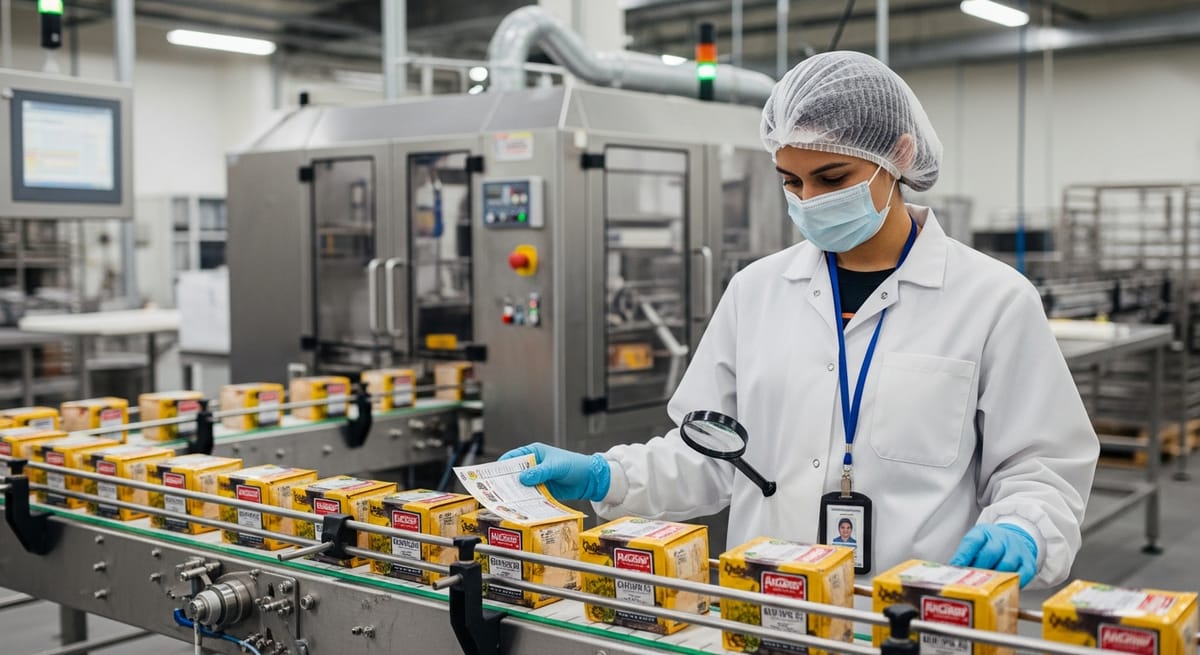
Allergen Control Without the Risks
Allergen control is one of the fundamental pillars of food safety at any company in the sector. Managing allergens properly isn't just a legal obligation — it's a direct responsibility toward consumer health. A serious allergic reaction can be fatal, and in most cases the root of the problem lies in gaps within the plant's own management system. In this article, we explain what you need to declare, what risks you need to control, and how a digital system like Solved can help you keep everything under control.
Which Allergens Must Be Declared, and Why
European regulation clearly and precisely sets out which substances must be declared on food labels. As stated in Regulation (EC) No 178/2002, laying down the general principles and requirements of food law (Regulation [EC] 178/2002, 2002), food business operators are responsible for ensuring that the food they sell is safe and correctly labeled, protecting consumers' right to accurate information.
The European Union currently recognizes 14 allergens that must be declared:
- Cereals containing gluten (wheat, rye, barley, oats, and their hybrid strains)
- Crustaceans
- Eggs
- Fish
- Peanuts
- Soybeans
- Milk (including lactose)
- Tree nuts (almonds, hazelnuts, walnuts, cashews, pecans, Brazil nuts, pistachios, and macadamia nuts)
- Celery
- Mustard
- Sesame seeds
- Sulphur dioxide and sulphites at concentrations above 10 mg/kg or 10 mg/l
- Lupin
- Molluscs
The obligation to declare these allergens applies to packaged food as well as food sold loose or served in catering. For quality managers in the food industry, knowing this list by heart is just the first step — managing it rigorously day to day is the real challenge.
Cross-Contamination Risks on the Plant Floor
One of the biggest challenges in food allergen control is cross-contamination. This happens when an allergen present in one product or ingredient unintentionally comes into contact with another product that shouldn't contain it. The most common routes for cross-contamination on the plant floor are:
- Shared production lines: when products with and without allergens are made on the same equipment without proper separation measures.
- Poorly cleaned utensils and equipment: product residue left on surfaces, pipes, pumps, or mixers can contaminate the next batch.
- Staff handling: operators can transfer allergens through their hands, clothing, or footwear if they don't correctly follow hygiene protocols.
- Poorly segregated raw materials: storing allergen ingredients next to allergen-free ones without the necessary physical barriers is a very common risk.
- Changeover mistakes: during product changeovers on the line, without a clear verification protocol, it's easy for traces of the previous product to remain.
Cross-contamination isn't always visible to the naked eye, which makes it especially dangerous. Rigorous allergen management needs to account for both direct and indirect contamination routes, and establish preventive controls for each one.
Good Control and Cleaning Practices
To minimize the risk of cross-contamination and ensure accurate, reliable allergen labeling, quality teams need to implement a set of well-established good practices. These practices should be documented, reviewed periodically, and known by everyone involved in production.
The most effective measures include:
- Allergen-specific risk analysis: integrated into the HACCP system, it should identify every critical point where contamination could occur and set control limits and corrective actions.
- Physical and time separation: whenever possible, allergen-containing products should be made on dedicated lines. If that's not feasible, separate production shifts and validated cleaning procedures between them should be established.
- Validated cleaning procedures: cleaning alone isn't enough — you have to prove it's effective at removing allergens. That means running surface tests (allergen swab tests) and documenting the results.
- Ongoing staff training: every operator needs to know what allergens are, why they're dangerous, and the protocols for their work area. Training should be documented.
- Reviewing technical data sheets and supplier specifications: any change in formulation or supplier can introduce new, undeclared allergens. Supplier management is therefore an essential part of allergen control.
- Label control: before every product launch, verify that the label correctly reflects the actual composition, including "may contain traces of…" statements.
All of these measures are part of the requirements set out by the leading food safety certification standards. Schemes like BRCGS Global Standards (BRCGS, n.d.) dedicate specific chapters to allergen management, precisely because it's one of the most heavily audited areas and where non-conformities are most frequently found.
How to Log and Trace Allergen Controls in Solved
Having good practices in place is essential, but without an efficient logging system it's very hard to prove compliance during an audit or react quickly to an issue. This is where Solved makes the difference for quality managers.
Solved is quality software designed specifically for the food industry that lets you digitize and centralize every control related to allergen management. Its most valued features in this area include:
- Digital logging of allergen controls: every check — from reviewing raw material data sheets to surface test results — is logged instantly with date, owner, and outcome, with no paper involved.
- Full batch traceability: the traceability module lets you track which allergen-containing raw materials went into each production batch, which line it was made on, and which finished products were affected. This is critical in the event of an alert or a product recall.
- Non-conformity and corrective action management: if a deviation is found in allergen controls, Solved lets you open a non-conformity instantly, assign owners, and track corrective actions through to closure.
- Automatic alerts and notifications: the system flags when a control is due or when a result exceeds the set limits, making sure no check gets missed.
- Audit reports: all documentation related to allergen control can be exported in an organized way to present to external auditors, saving the quality team hours of work.
Digitizing allergen control doesn't just improve the quality team's efficiency — it reduces the risk of human error, supports data-driven decisions, and, above all, protects consumers. In an increasingly demanding environment, having a tool like Solved is an investment in safety, reputation, and peace of mind.
If you'd like to learn more about how Solved can help you manage allergens at your plant, contact our team and we'll show you how it works, tailored to your production reality.
References
- BRCGS. (n.d.). BRCGS Global Standards. https://www.brcgs.com/
- Regulation (EC) No 178/2002 of the European Parliament and of the Council of 28 January 2002 laying down the general principles and requirements of food law. (2002). https://eur-lex.europa.eu/eli/reg/2002/178/oj?locale=en