Shelf Life of a Food Product: How to Calculate It
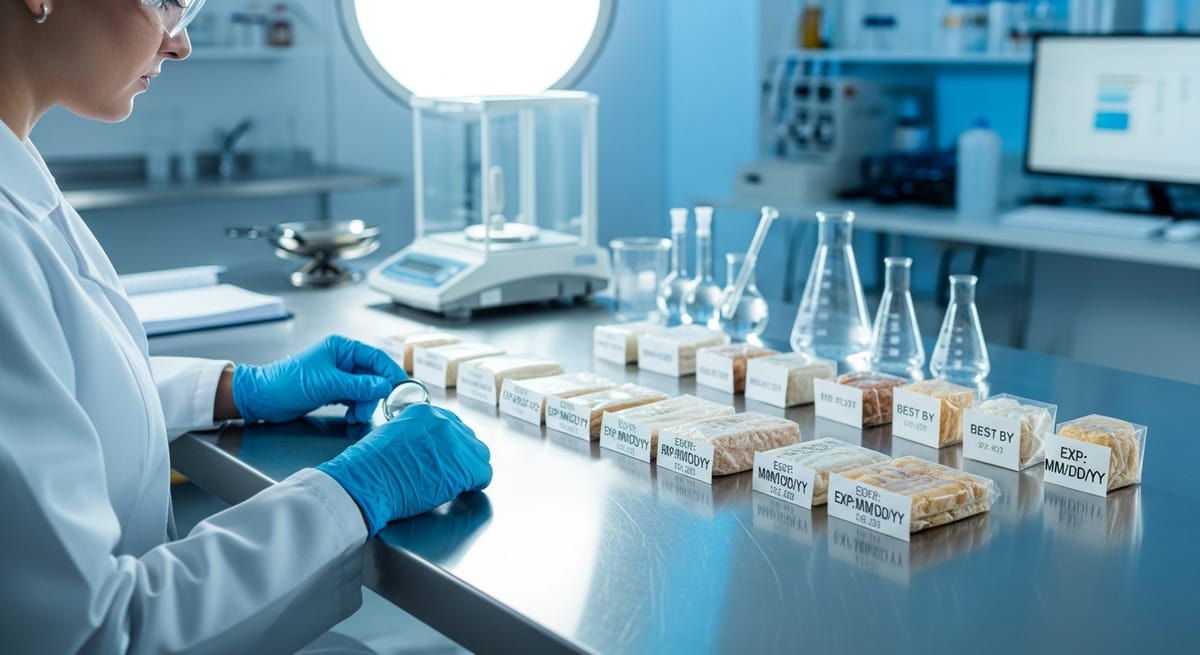
Shelf Life of a Food Product: How to Calculate It
Food shelf life is one of the most critical concepts in food quality management. Precisely determining how long a product keeps its sensory, microbiological and nutritional characteristics isn't just a legal obligation — it's a safety guarantee for the consumer and a reputational safeguard for the company. In this article we explain what shelf life is, how it's calculated, the difference between a use-by date and a best-before date, and how a tool like Solved can help you manage these studies in an organized, traceable way.
What shelf life is and what determines it
A food's shelf life is the period of time during which it retains its quality, safety and acceptability under defined storage conditions. In other words, it's the time that elapses from production until the food is no longer fit for consumption or starts to significantly lose its characteristic properties.
Correctly determining this period depends on multiple factors that interact with one another:
- Food composition: water activity (aw), pH, the presence of preservatives or antioxidants, and the initial microbiological load all have a huge effect on the product's durability.
- Manufacturing process: heat treatments, modified-atmosphere packaging or the use of physical barriers directly affect the food's stability.
- Storage and distribution conditions: temperature, relative humidity and light exposure are key variables that can speed up or slow down spoilage.
- Packaging material: the packaging's permeability to oxygen or moisture either protects the product from external agents or exposes it to them.
As set out in Regulation (EC) No 178/2002 (Regulation [EC] 178/2002, 2002), food business operators are responsible for ensuring that the foods they place on the market are safe, which includes rigorously understanding their products' shelf life and setting appropriate durability dates.
Methods for calculating shelf life: accelerated studies, challenge tests and microbiological analysis
Knowing how to calculate a food's shelf life requires combining different methods depending on the product type, the associated risk and the resources available. There's no single universal method — the usual approach is to apply several methods together.
Real-time shelf-life studies
The most direct method involves storing the product under its usual commercial conditions and running periodic checks — microbiological, physicochemical and sensory analysis — over time. It's the most reliable method, but also the slowest, since you have to wait for the product to exceed its expected shelf life.
Accelerated studies
Accelerated studies let you predict shelf life in less time by subjecting the food to more extreme temperature or humidity conditions. They're based on mathematical models such as the Arrhenius equation, which relates spoilage rate to temperature. They're especially useful when working with long-life products, where waiting months or years for results isn't practical.
Challenge test
The challenge test, or deliberate contamination trial, is a specific method for evaluating how pathogens or spoilage microorganisms behave under controlled conditions. The food is inoculated with the microorganism of interest and its growth or inhibition is studied throughout the shelf-life period. It's especially relevant for ready-to-eat products, as reflected in Regulation (EC) No 2073/2005 on microbiological criteria for foodstuffs (Regulation [EC] 2073/2005, 2005).
Microbiological and sensory analysis
Periodic microbiological testing lets you track the growth of spoilage organisms and pathogens over time. Alongside that, sensory evaluations (color, texture, smell, taste) carried out by trained or semi-trained panels provide valuable insight into when the product stops being organoleptically or commercially acceptable. Combining both approaches gives a complete picture of the product's real shelf life.
The difference between a use-by date and a best-before date
One of the concepts that causes the most confusion among consumers — and sometimes among industry operators too — is the distinction between a use-by date and a best-before date. Although both refer to a food's durability, they have very different legal and food-safety implications.
- Use-by date: applies to highly perishable foods from a microbiological standpoint, such as fresh meat, fish, dairy without sufficient heat treatment, or fresh-cut and ready-meal products. Once this date has passed, the food can pose a health risk and must not be sold or consumed. It's an absolute safety cutoff.
- Best-before date: indicates the period during which the food keeps its sensory and nutritional properties at their peak. After this date, the product can still be safe to eat, even though its quality characteristics may have declined. It's used on products such as cookies, canned goods, dry pasta or cereal.
As a quality manager, correctly deciding which type of durability label applies to each product is a decision that must rest on solid data and the evidence generated by shelf-life studies. Getting it wrong can lead to safety problems, customer complaints or regulatory penalties.
How to log and trace shelf-life studies in Solved
Designing and running shelf-life studies is only part of the job. The other part — just as important — is documenting, logging and making all the resulting information traceable. This is where many quality departments run into trouble: data scattered across spreadsheets, results buried in emails, sampling plans that never get updated, or reports that don't correctly link the batch tested to the result obtained.
Solved, the quality software for the food industry, lets you centralize the entire management of shelf-life studies on a single platform. With Solved you can:
- Plan and schedule studies: define control points, sampling dates and the tests to run for each product and batch, making sure no check ever gets missed.
- Log results in a structured way: enter microbiological, physicochemical and sensory data directly into the platform, linked to the product, the batch and the corresponding date.
- Trace and review the history: quickly access a product's full study history, visualize trends and compare results across batches or formulations.
- Generate audit reports: export the documentation needed to demonstrate to customers, certification bodies or competent authorities that your products' shelf life has been correctly determined and is backed by evidence.
- Manage alerts and deviations: set up automatic alerts whenever a result exceeds established limits, making immediate decision-making easier.
The end goal is for shelf-life studies to stop being a one-off formality and become a strategic tool for continuous quality improvement. With organized, digital management, quality managers can make data-driven decisions, reduce food waste by setting dates more precisely, and respond quickly to any issue or audit.
Getting a food's shelf life right is, ultimately, an act of responsibility toward the consumer and a competitive advantage for the company. Having the right methods and the right digital tools is what separates reactive quality management from truly professional quality management.
References
- Regulation (EC) No 178/2002 of the European Parliament and of the Council of 28 January 2002 laying down the general principles and requirements of food law. (2002). https://eur-lex.europa.eu/eli/reg/2002/178/oj?locale=en
- Regulation (EC) No 2073/2005 of the Commission of 15 November 2005 on microbiological criteria for foodstuffs. (2005). https://eur-lex.europa.eu/eli/reg/2005/2073/oj?locale=en