Quality Software for Fresh Produce Packers
Quality Software for Fresh Produce Packers
Managing quality at a fresh produce packing house has nothing in common with doing it at a continuous-production factory. Volumes swing from one day to the next, most of the staff is seasonal, raw material arrives from multiple origins, and customers demand ever more documentary guarantees. In that context, having quality software for the fresh produce industry stops being optional and becomes a genuine operational necessity. In this article we explain what that tool needs to cover and how it can keep up with the demanding pace of a packing campaign without slowing down dispatch.
Critical quality points at a fresh produce packing house
Before talking about digital solutions, it's worth getting a clear picture of the process. A fresh produce packing house has several control points where quality can fail — or where it needs to be perfectly recorded — to guarantee safety and customer satisfaction.
Field receiving. The first critical moment. This is where size, sanitary condition and possible handling damage are assessed, and where essential information about the delivery's origin is captured. A mistake at receiving carries problems through the entire chain.
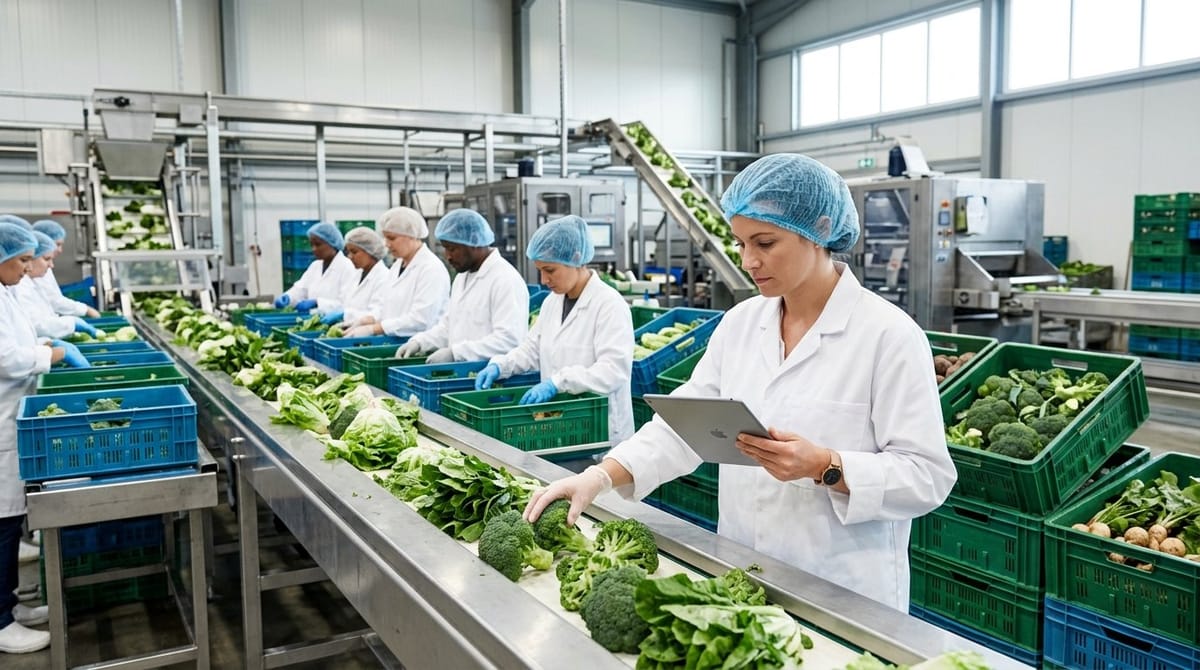
Sizing and the processing line. Sizing generates a constant stream of issues: out-of-size product, foreign bodies, visual defects. Logging those issues in real time is essential both for immediate decisions and for building historical data that improves each campaign.
Cold rooms. Temperature and humidity control in cold storage is a classic HACCP point, but so is tracking storage time by batch. Mixing deliveries without proper identification is one of the mistakes that causes the most traceability problems in audits.
Fresh-cut produce. Fresh-cut products — washed, cut and packaged vegetables ready for consumption — add an extra layer of microbiological and shelf-life complexity. Regulation (EC) No 2073/2005 on microbiological criteria for foodstuffs (Regulation [EC] 2073/2005, 2005) sets the limits that need to be verified for this type of product, requiring rigorous analytical and documentary follow-up on every batch shipped.
Why paper and Excel can't survive a campaign with volume spikes and seasonal staff
During peak campaign months, a fresh produce packing house can triple or quadruple its workload within days. The seasonal staff brought on for those peaks doesn't know internal procedures, paper records pile up unreviewed, and the quality manager ends up firefighting, signing documents they haven't had time to review.
Excel, for its part, has obvious limitations in this environment: it doesn't support multiple users working simultaneously on the floor without risk of errors, it doesn't generate automatic alerts when a parameter falls out of range, and it offers no traceability of who logged what and when. In a BRCGS Global Standards (BRCGS, n.d.) or IFS Food audit, that lack of documentary traceability can amount to a major non-conformity.
And when the market demands the recall of a specific batch — because of a pesticide residue alert, for example — response speed depends directly on the quality of your record-keeping system. With paper and Excel, tracking down every destination of a batch in under four hours is, in most cases, simply not achievable.
Fresh produce quality software: what it needs to cover
Quality software for the fresh produce industry can't be a generic tool forced to fit. It needs to answer the sector's particular challenges: raw material variability, campaign-based work, multiple product origins, and different commercial requirements depending on the sales channel. Here are the modules you can't do without.
Raw material receiving control. The software should let you log the quality parameters agreed with the supplier at the moment of unloading: size, color, firmness, defects, arrival temperature. That data needs to be automatically linked to the delivery so it can be looked up at any later point in the process. You can find more on managing raw material receiving in our glossary.
Pesticide residue control. Managing residue testing is one of the most sensitive points in the sector. The software should let you link test results to each delivery, automatically compare them against current maximum residue limits (MRLs), and block a batch from shipping while testing is pending or if the result is non-compliant.
Full fruit and vegetable traceability. Traceability of a delivery needs to cover everything from field origin through to the customer's destination, including every intermediate transformation: batch mixing, packaging, palletizing. This is what's required by Regulation (EC) No 178/2002 on the general principles and requirements of food law (Regulation [EC] 178/2002, 2002), which requires operators to be able to identify their suppliers and their immediate customers at any time.
Line issue management. When an operator spots a problem on the sizing or packaging line, they need to be able to log it immediately from a mobile device or tablet. The software has to notify the quality manager in real time, allow corrective actions to be assigned, and track each issue through to closure. Without that digital workflow, issues get lost or stay locked in people's memory.
Digitizing quality at a fresh produce packing house also means integrating cold room temperature records, finished product controls and the documentation tied to each shipment, so the quality manager can see the plant's overall status from a single dashboard, without physically walking every control point.
How Solved keeps pace with a fresh produce packer's campaign without slowing down dispatch
Solved is quality software built specifically for the food industry, and its rollout at fresh produce packing houses is designed not to interfere with the dispatch speed the fresh market demands.
The interface is optimized for use on the plant floor with touch devices: receiving and in-line control forms are simple, quick to fill in, and require no extensive training — essential when the team changes with every campaign. Seasonal staff can start logging data correctly on their very first shift.
Solved's traceability module lets you run a complete traceability exercise — locating every batch affected by a specific origin or test result — in minutes, not hours. That makes all the difference when a customer or a health authority demands an urgent response.
Solved is also configured around each company's own quality criteria: acceptance ranges, the parameters measured at each control point, and who receives alerts, all adapt to your operation, not the other way around. You can learn more about how we approach quality control for the food industry on our blog.
If you'd like to see how Solved can fit into your packing house's process, request a no-obligation demo. We'll walk you through the tool using real cases from the sector and answer the specific questions about your operation.
References
- BRCGS. (n.d.). BRCGS Global Standards. https://www.brcgs.com/
- Regulation (EC) No 178/2002 of the European Parliament and of the Council of 28 January 2002 laying down the general principles and requirements of food law. (2002). https://eur-lex.europa.eu/eli/reg/2002/178/oj?locale=es
- Commission Regulation (EC) No 2073/2005 of 15 November 2005 on microbiological criteria for foodstuffs. (2005). https://eur-lex.europa.eu/eli/reg/2005/2073/oj?locale=es