Quality Software for Animal Feed Mills
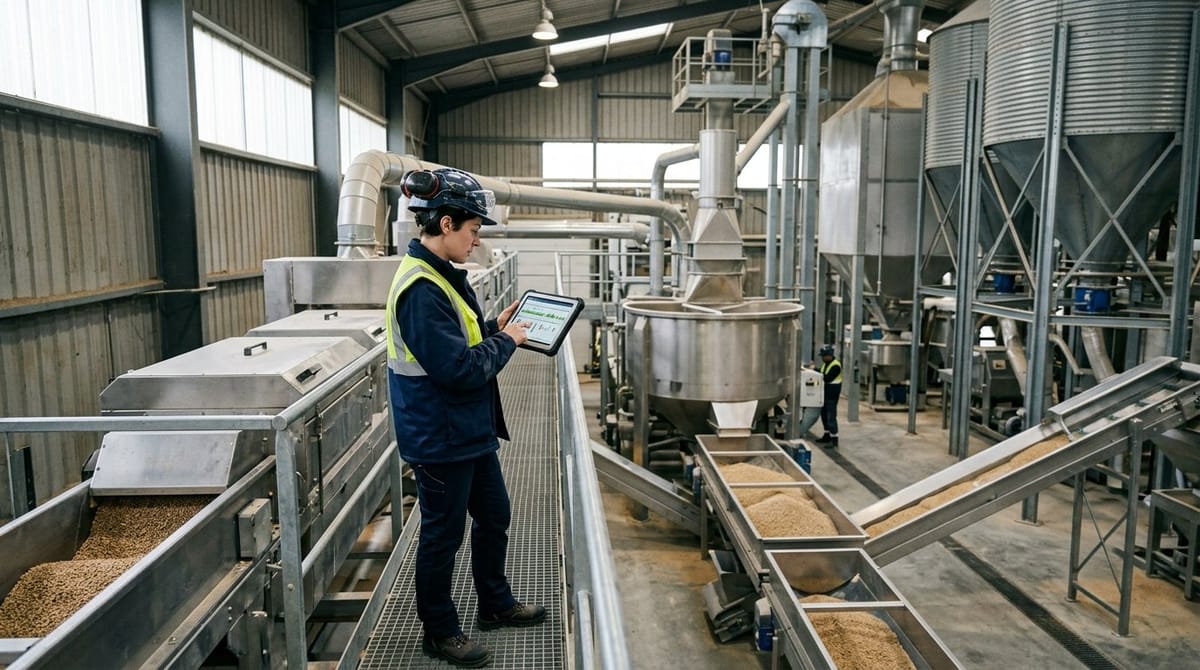
Quality Software for Animal Feed Mills
Managing quality at a feed mill goes far beyond keeping a few basic records. The complexity of the processes, the variability of raw materials, and the pressure of certification audits mean that having specialized quality software for animal feed is, today, a genuine necessity rather than a technology luxury. In this article we explain why generic solutions fall short and what a tool built for the reality of animal nutrition needs to deliver.
Critical quality points at a feed mill: raw materials, dosing and cross-contamination between batches
A compound feed mill works with dozens of ingredients — cereals, vegetable and animal proteins, additives, premixes — whose quality varies from supplier to supplier, harvest to harvest, and even truck to truck. Quality control at feed mills therefore starts at receiving: every raw material delivery must be tested, compared against the supplier's specifications, and approved before it enters a silo or warehouse.
From there, the risks multiply. Incorrect dosing of an additive — a micronutrient or a coccidiostat, for example — can cause both nutritional deficiencies and overdoses with serious consequences for the animals and, ultimately, for the food chain. Regulation (EC) 178/2002 on general food law (Regulation [EC] 178/2002, 2002) establishes that safety must be guaranteed across the whole chain, including animal feed, which requires manufacturers to prove their controls are effective and documented.
The third major critical point is cross-contamination between batches. On a production line that might make medicated or allergen-containing feed on one shift and conventional feed on the next, line clear-down management and cleaning validation are processes that can't rely on an operator's memory or a sheet of paper.
Why GMP+ and FAMI-QS audits demand more than spreadsheets
Certification standards specific to animal nutrition — mainly GMP+ BC10 and FAMI-QS — share a common requirement: full traceability and immediate access to records. During an audit, the inspector can ask, within minutes, for a raw material's receiving record, that batch's test results, the formula's dosing records, and the finished product's outgoing delivery note. If that information is scattered across several spreadsheets, shared folders, or even paper, response time becomes a problem in itself.
On top of that, certification schemes themselves keep evolving to align with frameworks like the one recognized by the Global Food Safety Initiative (GFSI) (GFSI, n.d.), which drives the harmonization of food safety management systems globally. This means feed manufacturers need to maintain not just records, but evidence that their control systems are robust, regularly reviewed and continuously improved. Spreadsheets, by nature, don't generate a change history, don't send automatic alerts, and don't support trend analysis. They're valid tools for one-off tasks, but insufficient to sustain an audited animal feed quality management system.
The practical consequence is clear: companies still managing quality with spreadsheets spend extra hours before every audit gathering and organizing data that specialized software would keep permanently ready and consistent.
What feed quality software needs to cover: batch traceability, supplier control and plant-floor issues
When we talk about compound feed quality software, we're not talking about a simple document manager. A solution that's genuinely useful for a feed mill needs to cover, at minimum, the following functional areas:
Full batch traceability. Feed traceability requires being able to trace, forward and backward, every ingredient from its origin through to the finished product delivered to the customer. That means automatically linking each raw material receipt to the formulas it was used in and to the finished product batches produced. If a problem is detected in an ingredient, the system should immediately show which feed batches are affected and whether they've already left the mill.
Supplier control. Each supplier's history — test results, issues, approval status, current certificates — needs to be centralized and accessible. A good system lets you configure alerts when a supplier's certificate is about to expire, or when a delivery's test results deviate from the agreed specifications, helping you catch problems before they reach the production line.
Issue and non-conformity management. Any deviation detected — whether at receiving, during manufacturing, or in the finished product — needs to be logged with its root cause, the corrective actions taken, and follow-up on their effectiveness. This closed-loop continuous improvement cycle is one of the things auditors scrutinize most closely.
Testing plans and parameter control. The software should let you define sampling and testing plans by raw material or product type, log results the moment they're obtained — whether entered manually or imported from the lab — and automatically compare them against specified limits, generating alerts when they're exceeded.
Integrated document management. Spec sheets, specifications, operating procedures, cleaning records and process validations should live in the same environment as operational data, with version control and access by user profile.
If you want to learn more about how these capabilities apply across the food industry in general, check out our article on quality control software for the food industry.
How Solved fits a feed mill's process without slowing down production
At Solved, we understand that a feed mill can't afford to have a new tool rollout cause stoppages, friction on the floor, or pushback from the production team. That's why our approach always starts with how the customer actually works: we analyze existing process flows, identify where quality is already being controlled today — even if it's on paper — and build the software's configuration on that reality, not on a generic template.
The result is a system that plant operators can use from terminals or tablets right at the control point, with no need for advanced technical training, while giving the quality manager a complete, real-time view of the status of every active control. When a raw material delivery gets blocked due to an out-of-spec test result, the system communicates it automatically and logs who decided to release or reject it, on what basis, and when.
Traceability, supplier management, testing plans and issue logging all work together, which means there's no need to enter the same data in multiple places or manually cross-reference information to prepare an audit report. Everything is connected, everything is logged, and everything is available in a few clicks.
If you manage quality at a feed mill and want to see how Solved can adapt to your specific process, we invite you to request a demo. Together, with no obligation, we'll work through your biggest animal feed quality control challenges.
References
- Global Food Safety Initiative. (n.d.). Global Food Safety Initiative (GFSI). https://mygfsi.com/
- Regulation (EC) No 178/2002 of the European Parliament and of the Council of 28 January 2002 laying down the general principles and requirements of food law. (2002). https://eur-lex.europa.eu/eli/reg/2002/178/oj?locale=es