Food Audit Software: How to Choose the Right One
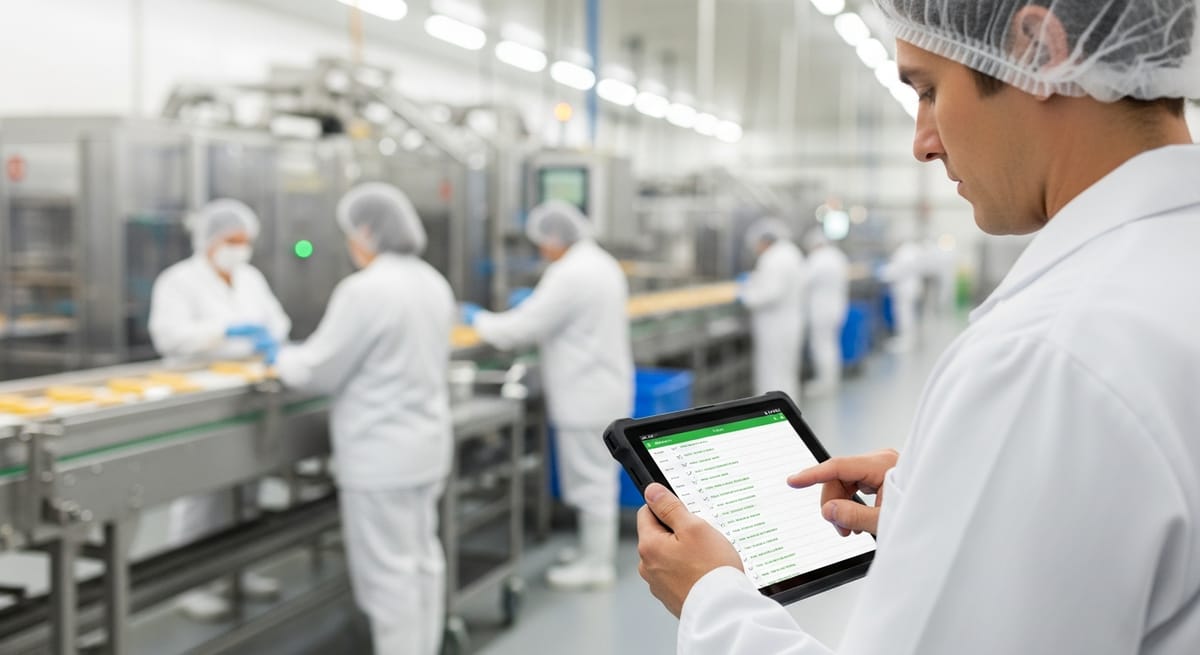
Food audit software: how to choose the one that actually works on the plant floor
Choosing food audit software is one of the most strategic decisions a quality manager in the food industry can make. It's not just about swapping a paper binder for a screen — it's about making sure every audit, internal or external, is documented perfectly, findings get closed on time, and the plant team can work without being tied to a desktop computer. If you're evaluating your options, this article will help you identify the criteria that actually matter and why digitization makes all the difference when a demanding certification comes around.
What food audit software needs to solve
Before comparing tools, it's worth being clear on the full cycle the software has to cover. An audit doesn't start when the auditor walks into the plant — it starts weeks earlier, with scope planning, assigning owners and preparing the specific checklists for each area or process. Good quality audit software should let you create and schedule audits in advance, assign them to specific people, and send automatic reminders so nothing slips through the cracks in the calendar.
During the on-site audit, the system needs to be just as agile as the auditor: real-time response capture, the ability to attach photo evidence from a phone, and immediate logging of observations and non-conformities. The smoother this phase runs, the more accurate the final report will be.
And after the audit comes the most critical part — and, paradoxically, the most neglected one when working with paper or Excel: closing findings. The software needs to link every non-conformity to a corrective action, assign it to an owner, set a deadline, and send automatic alerts until the finding is closed and verified. Without this follow-through, the value of the audit fades away within weeks.
Why paper and Excel fall apart the moment IFS or BRCGS come knocking
Many mid-sized food companies still manage their audits with spreadsheets and Word documents. This model works reasonably well when audit volume is low and requirements are limited. But the moment you're preparing for certification against an internationally recognized standard, the system breaks down.
Standards like IFS Food (IFS, n.d.) or BRCGS (BRCGS, n.d.) require you to prove not just that audits happen, but that findings are managed systematically, that corrective actions have supporting evidence, and that there's full traceability from finding to closure. With Excel, proving all of that to an external auditor turns into a scramble through scattered files, emails and scanned signatures.
On top of that, Excel doesn't validate data, doesn't send alerts, and can't guarantee that the checklist version one technician used on one line is the same one another technician used on a different line. That lack of version control is, on its own, a major non-conformity risk under any certification scheme recognized by the Global Food Safety Initiative (GFSI, n.d.).
The conclusion is clear: paper and Excel are tools for recording, not for managing. And the difference between recording and managing is exactly what separates a company that sails through an IFS or BRCGS audit from one that racks up avoidable minor observations.
Features that make the difference: photo evidence, signatures, linked corrective actions and full finding traceability
When you're evaluating a food audit app, there are features that seem like small details but end up delivering the most value in practice. Here's what you shouldn't overlook:
Built-in photo evidence. The auditor should be able to take a photo from within the app itself and have it attach automatically to the relevant finding. If the process requires leaving the app, opening the gallery, and then importing the image, most auditors will end up skipping the step. A photo is the most objective proof of a non-conformity — and of its later correction.
Digital signatures on the floor. Being able to capture the area owner's or auditee's signature directly on the mobile device or tablet closes the legal and documentary loop of the audit. It eliminates printing, scanning and lost physical documents.
Corrective actions linked to the finding. Every non-conformity should generate a corrective action automatically, or with a single click, complete with an owner, deadline and status. The system should let the owner update progress from their own access, and let the quality manager validate closure. This automated flow is what turns an audit into a genuine continuous-improvement tool.
Full finding traceability. You should be able to check the complete history of a finding at any time, from any device: when it was detected, who detected it, what action was defined, who carried it out, when it was closed, and who verified it. This traceability is essential both for external audits and for internal trend analysis.
If the software you're evaluating doesn't cover these four points in an integrated way, you'll end up managing part of the process outside the tool in practice.
How Solved covers the full audit cycle with unlimited users
At Solved, we designed the audit module with exactly these scenarios in mind: a plant with multiple shifts, multiple auditors, and an IFS or BRCGS certification on the horizon.
Audit planning in Solved is visual and flexible: you can schedule recurring audits, assign them to specific owners, and set up automatic reminders. Checklists are created from the platform and can be customized by audit type, area or process, ensuring every auditor always works from the current version.
During execution, auditors work from the mobile app: they log responses, attach photos, add comments, and generate findings in real time, without needing a constant internet connection. The auditee's digital signature is captured on the same device at the end of the audit.
Every finding automatically generates a linked corrective action, with an assigned owner and deadline. The system sends notifications to the assigned owner and due-date alerts to the quality manager. Closure of the finding is documented with photo evidence and a verification signature, creating full traceability that you can export in any format to present to an external auditor.
One of the advantages our customers value most is the unlimited users policy: you don't pay extra to add a new quality technician, an invited external auditor, or a plant manager who wants to check on audit status. This removes a common adoption barrier and lets the whole organization work on the same platform.
If you want to better understand how to prepare your team before an external audit arrives, we recommend reading our article on how to prepare for food quality audits without the stress. And if you'd like to see Solved's audit module in action, you can request a no-obligation demo from our audits page.
Digitizing audits isn't a luxury reserved for large corporations. It's the most practical, efficient way to make sure the effort put into every audit translates into real improvement, solid documentation, and peace of mind when the external auditor arrives.
References
- BRCGS. (n.d.). BRCGS Global Standards. https://www.brcgs.com/
- Global Food Safety Initiative. (n.d.). Global Food Safety Initiative (GFSI). https://mygfsi.com/
- International Featured Standards. (n.d.). IFS Certification. https://www.ifs-certification.com/