AI in quality control
AI in quality control
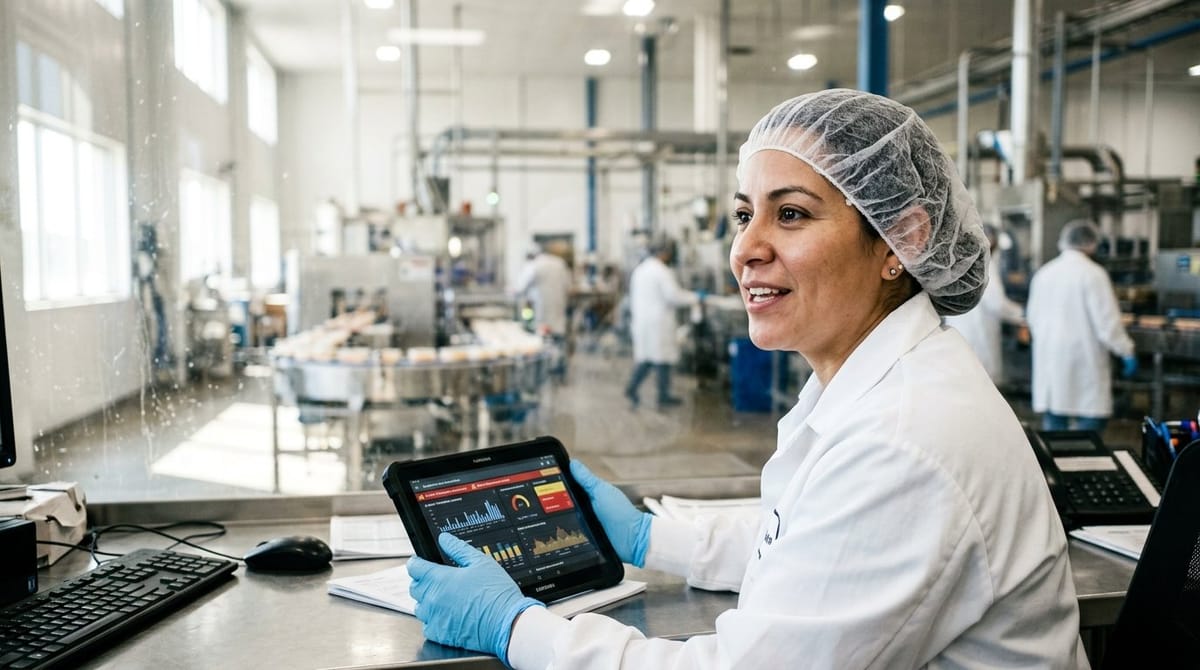
AI in food quality control has stopped being a promise for the future and become a tool already at work on many plant floors and in quality departments. We're not talking about robots or science fiction: we're talking about systems capable of classifying issues, spotting anomalous patterns and raising alerts before a minor problem turns into a crisis. For quality managers in the food industry, understanding what AI can do today — and what its limits still are — is essential for making well-informed decisions.
Where AI fits in food quality control today
Artificial intelligence applied to food quality isn't here to replace entire processes overnight. Its most immediate value sits in three very specific areas: automatic issue classification, generating early alerts, and pattern detection that the human eye would struggle to catch across hundreds of records.
When a production line generates dozens of records a day, a recurring but minor deviation can easily get buried under the volume of data. An AI-powered system can analyze that history in seconds, spot that a temperature deviation happens every Tuesday afternoon at a specific point, and raise an alert before the problem escalates. This is exactly what's explored in depth in the article on how to detect issue patterns, which describes how to move from reactive management to anticipatory management.
Another area where AI is proving its worth is AI-driven food traceability. By cross-referencing batch, supplier, storage condition and audit result data, intelligent systems can automatically link an issue to its likely origin, drastically cutting investigation time. This not only improves efficiency but also strengthens compliance with the traceability obligations set out in Regulation (EC) No 178/2002 (Regulation [EC] 178/2002, 2002), which requires food operators to be able to identify any substance incorporated into their products.
In short, AI fits into quality control today as a layer of analysis and automation that works on the data you already have, making it more useful and actionable.
What AI still can't replace: a quality manager's judgment and human verification
Let's be honest: artificial intelligence has real limits, and ignoring them in the food industry can be costly. However sophisticated a model may be, it can't replace the expert judgment of a quality manager with years of experience on the plant floor.
AI works with historical data and known patterns. When a new, unusual situation comes up, or one that depends on contextual factors that are hard to digitize (a negotiation with a supplier, a recent procedure change, an organoleptic observation), the system can fail or simply lack enough information to act. That's where human verification becomes essential.
What's more, legal and technical responsibility for quality decisions always sits with people. Automating doesn't mean delegating responsibility to an algorithm. It means freeing up time and attention so the quality manager can focus on what genuinely requires their judgment: complex decision-making, communicating with teams and suppliers, and continuous improvement of the system.
Another critical factor is input data quality. AI is only as good as the data it receives. If records are incomplete, poorly structured or entered inconsistently, the system will produce unreliable results. That's why, before implementing any AI solution, it's worth reviewing and consolidating your quality database.
Real cases: automated notice inboxes and AI-assisted issue drafting
One of the most widespread use cases, and one with the fastest return, is automated notice inboxes. Many food companies receive issue reports by email or forms from different channels: suppliers, operators, customers, labs. Manually classifying and prioritizing those notices eats up valuable time.
With AI, it's possible to analyze the text of those messages, classify the issue by type and severity, automatically assign it to the right person, and generate a first draft record. The quality team receives the issue already organized, with the relevant information highlighted, and can focus on validating and acting rather than on admin work. If you want to go deeper on how to structure this kind of workflow, the article on automated workflows for assigning issues to the right owner offers a very useful practical guide.
Another real case is AI-assisted issue report drafting. Instead of writing from scratch every time a non-conformity is detected, the system proposes a draft based on the logged data: the affected batch, the control point, the deviation detected, similar past actions. The manager reviews, adjusts and validates. The time saved can be significant, especially for companies with a high volume of issues. To see how this approach fits into generating periodic reports, it's worth reading the article on quality report automation.
These aren't theoretical cases. They're features already available in quality management tools like Solved, built specifically for the food industry.
How to start using AI in quality without compromising traceability
If you're considering bringing artificial intelligence into your quality system, the key is doing it gradually, in a structured way, with the right controls in place. Here's a practical approach to get started:
1. Audit your current data. Before implementing any solution, review the state of your records. Are they digitized? Are they consistent? Are they clearly linked to batches and control points? Without a solid data foundation, AI can't generate real value.
2. Identify a specific use case. Don't try to automate everything at once. Start with a process that has a high volume of repetitive tasks and low risk of critical error: for example, initial issue classification or draft report generation.
3. Always keep human validation in the loop. Any action generated by AI must go through a manager's review before it's executed or logged as final. This is especially important to guarantee the integrity of traceability, which must be complete, verifiable and auditable at all times.
4. Measure the impact. Define clear indicators before you start: issue management time, classification error rate, response time to alerts. Measuring lets you justify the investment and spot areas for improvement.
5. Choose tools designed for the industry. Generic AI solutions may not adapt well to the regulatory and operational particularities of the food industry. Look for software that already builds in food quality logic, sector-specific workflows and compatibility with standards recognized by ISO (ISO, n.d.).
Artificial intelligence isn't a magic fix, but it is a real competitive advantage for quality departments that know how to integrate it with judgment. The goal isn't to automate for automation's sake, but to put human intelligence where it matters most.
References
- International Organization for Standardization. (n.d.). ISO 22000 and ISO 9001. https://www.iso.org/
- Regulation (EC) No 178/2002 of the European Parliament and of the Council of 28 January 2002 laying down the general principles and requirements of food law. (2002). https://eur-lex.europa.eu/eli/reg/2002/178/oj?locale=es