Process Control in Food Production
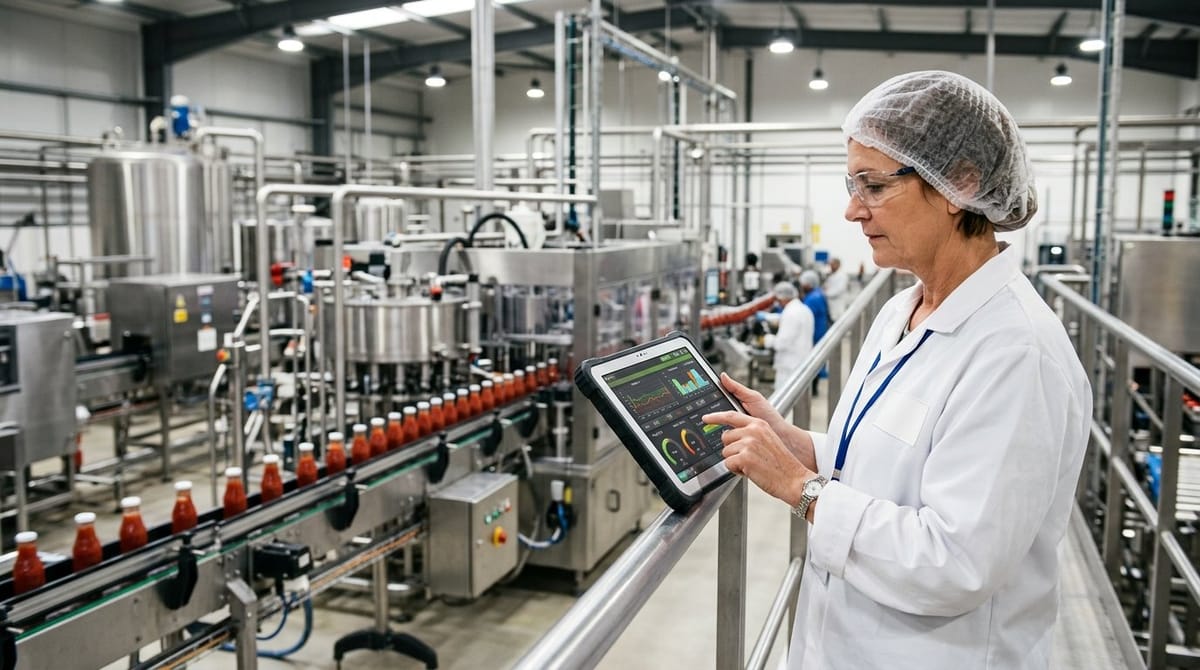
Process control in food production
Process control is one of the pillars food safety rests on at any production plant. Making sure every stage of the production process stays within the set parameters isn't just a regulatory requirement: it's the difference between a product that reaches the consumer in optimal condition and one that triggers a non-conformity, a complaint or, in the worst case, a health alert. For quality managers in the food industry, understanding what process control involves and how to optimize it is a strategic priority.
What process control is and how it differs from statistical process control (SPC)
Process control means monitoring the critical parameters of each production stage in real time — temperature, time, pressure, humidity, pH — to catch deviations the moment they happen and act before they affect the product. Its goal is to keep the process within defined operating limits, taking corrective or preventive action immediately.
Statistical process control (SPC), on the other hand, goes a step further: it uses statistical tools like control charts or capability indices (Cp, Cpk) to analyze process variability over time. Its value isn't in catching a one-off deviation — it's in identifying trends, systematic causes of variation and opportunities for continuous improvement.
Put simply: process control tells you if something is wrong right now. SPC tells you why it keeps going wrong. Both approaches are complementary and necessary for a food plant that wants to operate rigorously. As set out in Regulation (EC) 852/2004 on the hygiene of foodstuffs (Regulation [EC] 852/2004, 2004), food business operators must apply procedures based on HACCP principles, which inherently means identifying and monitoring the critical points of the production process.
The parameters most closely controlled at food plants
Not every parameter carries the same weight in terms of safety and quality, but there's a group that accounts for most of the monitoring effort in the food industry. Production parameter control centers mainly on four variables:
Temperature. This is the most critical parameter in the vast majority of food processes. From cooking and pasteurization to chilled or frozen storage, a deviation of just a few degrees can compromise product safety. Temperature ranges are typically critical control points (CCPs) within the HACCP plan.
Time. Exposure time at a given temperature or process condition is inseparable from temperature itself. A pasteurization cycle doesn't just require reaching a minimum temperature — it has to be held for long enough to guarantee pathogen destruction. In many processes, the time-temperature relationship is the pairing that determines the safety of the final product.
Pressure. In processes like vacuum packaging, high-pressure processing (HPP) or steam systems, pressure is a direct indicator that the process is running correctly. A pressure variation can signal an equipment failure or a process deviation that affects both safety and the product's sensory characteristics.
Humidity. In sectors like industrial baking, dehydration, cured meat production or snack manufacturing, relative ambient humidity or the product's own water activity (aw) are key parameters for shelf life and microbiological safety. Poor humidity control can encourage mold and yeast growth or speed up product degradation.
What happens when process control depends on manual rounds with paper checklists
For decades, the standard control model on the plant floor has been the manual round: an operator or quality technician walks the production line at set intervals, logs equipment readings on a paper form, and signs the control sheet. This system has a structural problem that has nothing to do with anyone's good intentions: it introduces a lag between the moment a deviation happens and the moment someone catches it.
If a cold room starts climbing in temperature at 2:00 a.m. and the next round isn't scheduled until 6:00 a.m., that's four hours during which the product is exposed to unsuitable conditions without anyone knowing. By the time the technician logs the issue, the damage is already done.
Paper records also create other common headaches for quality departments: illegible or incomplete data, difficulty consolidating information across lines or shifts, no easy way to track trends, and a high cost in document management time. During external audits — whether certification audits against standards like BRCGS (BRCGS, n.d.) or inspections by the competent authorities — proving effective process control with paper records is cumbersome and leaves room for questions.
Monitoring production processes based solely on manual records isn't a methodology problem — it's a response-speed problem. And in food safety, how fast you respond to a deviation is critical.
How a real-time dashboard connects process control with the non-conformities and issues it triggers
The real leap forward in real-time process control happens when production data stops living on paper sheets or disconnected spreadsheets and gets integrated into a digital dashboard that centralizes the information and makes it actionable the moment it's generated.
A system like this means that as soon as a parameter — say, the temperature of a cooking oven — exceeds the set critical limit, an alert is generated automatically. That alert doesn't sit on a sheet someone will review at the end of the shift: it immediately becomes an issue inside the quality system, gets assigned to an owner, and is linked to the affected batch or product. The quality manager can see in real time what's happening on each line, at what point in the process the deviation occurred, and which product might be affected.
Integrating plant-floor process control with non-conformity management removes the manual transcription step, reduces the risk of an issue going unrecorded, and provides the full traceability that's essential both for internal continuous improvement and for responding quickly to an inspection or a certification audit.
From a regulatory standpoint, this approach directly answers the traceability requirements set out in Regulation (EC) 178/2002 laying down the general principles and requirements of food law (Regulation [EC] 178/2002, 2002), which requires operators to be able to quickly identify any product that could pose a risk to consumer health.
Real-time process control isn't just an operational improvement — it's a competitive advantage. Plants that have made this move report less waste, fewer blocked batches, smoother audits and, above all, greater confidence from the quality team in the data behind their decisions. Because ultimately, controlling the process means controlling the product. And controlling the product means protecting the consumer and the company.
References
- BRCGS. (n.d.). BRCGS Global Standards. https://www.brcgs.com/
- Regulation (EC) No 178/2002 of the European Parliament and of the Council of 28 January 2002 laying down the general principles and requirements of food law. (2002). https://eur-lex.europa.eu/eli/reg/2002/178/oj?locale=en
- Regulation (EC) No 852/2004 of the European Parliament and of the Council of 29 April 2004 on the hygiene of foodstuffs. (2004). https://eur-lex.europa.eu/eli/reg/2004/852/oj?locale=en