Digital Checklists for Quality Control
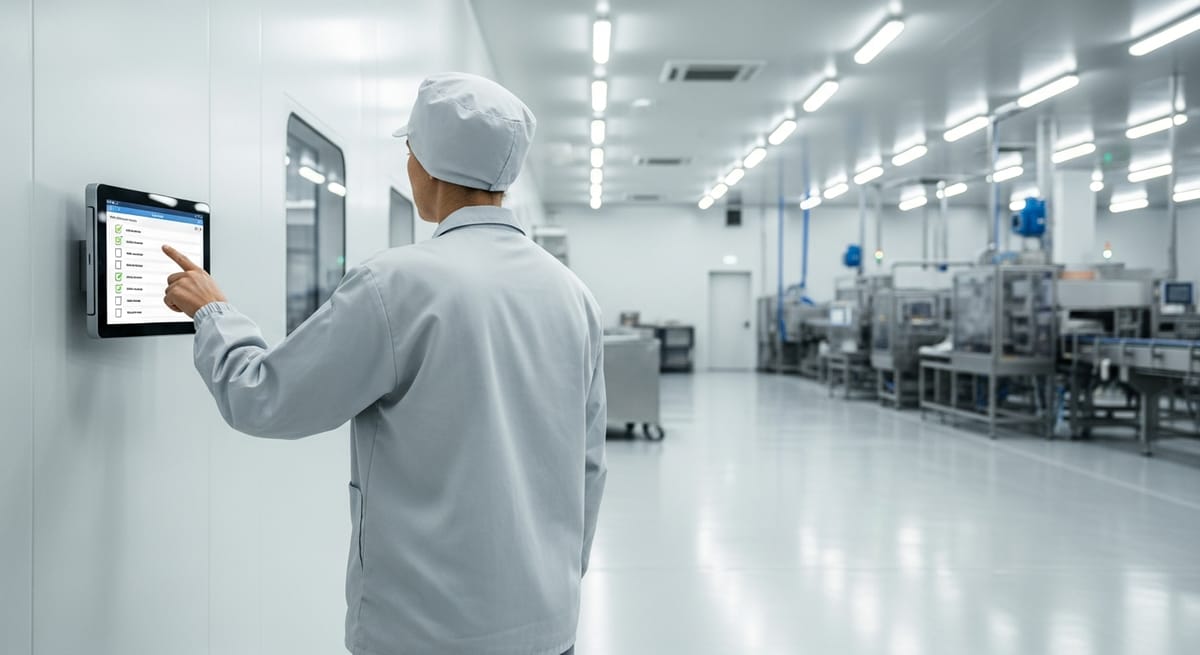
Digital Checklists for Quality Control
On any factory floor in the food industry, digital checklists have become one of the tools quality managers ask for most. That's no coincidence: regulatory pressure, increasingly demanding audits, and the need to prove traceability in real time are all making it harder to justify sticking with paper-based controls. If you're still working with binders, printed sheets, and pens, this article explains why it's time to make the switch.
Why Paper Checklists Go Missing Right When You Need Them
Every quality manager has lived through the same scenario: an inspection shows up, a customer asks for evidence of a specific control performed three weeks ago, or a non-conformity appears and someone has to reconstruct what happened. At that point, someone goes looking for the paper record. And the paper record simply isn't there. Or it's incomplete. Or the ink ran. Or the operator who filled it in ticked every box without actually doing the check.
The problem with paper records isn't just storage. It's a problem of reliability, traceability, and, above all, timeliness. A checklist signed after the fact, filled in from memory at the end of a shift, loses all its value as evidence. And when it comes to food safety, that loss of evidence can have very serious regulatory and reputational consequences.
On top of that, managing checklists manually carries a huge hidden cost: someone has to collect those papers, scan them, file them, and dig them up again when they're needed. Hours and hours of administrative work that add no value to the production process.
What You Gain With a Digital Checklist: Mandatory Fields, Photo Evidence, Timestamp and Owner
Switching to digital checklists isn't just swapping paper for a screen. It's a structural shift in how control data is captured, validated, and managed. Here are the most concrete advantages that make a difference day to day:
Mandatory fields. On a paper checklist, an operator can hand in the record with blank boxes. On a well-configured digital checklist, the system won't let you move forward or close the form if any field is left empty. That eliminates incomplete records at the source and forces every control to be documented in full.
Photo as evidence. Digital checklists let you attach photos directly to the record. Is there a dirty spot in a hard-to-clean area? Does the delivery truck's temperature not match what was declared? The operator can capture an image on the spot, automatically linked to the corresponding control. That photo carries real evidentiary weight in an audit.
Automatic timestamp and owner. Every time a digital checklist is completed, the system automatically records who did it and exactly when. There's no way to backdate or alter a record without leaving a trace. That strengthens traceability and accountability — something increasingly required by standards like BRCGS Global Standards (BRCGS, n.d.) during certification audits.
Real-time alerts and deviations. When a value falls outside the accepted range, the system can automatically trigger an alert or open an issue linked to the failed control. That way the quality team can react immediately instead of discovering the problem days later while going through paperwork.
Which Controls to Digitize First (Cleaning, Receiving, Line Startup)
Digitization doesn't have to be all-or-nothing. In fact, the best approach is to start with the most critical, most frequently recorded controls. These are the three most common starting points in food plants:
Cleaning and disinfection controls. These are the records most often filled in routinely and without much thought. Digitizing these checklists lets you confirm they were carried out at the right time, with the right products, and by the person responsible. It also makes it easier to track recurring issues in specific areas or equipment.
Raw material receiving controls. Receiving is one of the most sensitive critical control points in any HACCP system. Checking the vehicle's condition, arrival temperature, labeling, supplier documentation, and more — all of this needs to be reliably documented, as required by Regulation (EC) 852/2004 on the hygiene of foodstuffs (Regulation [EC] 852/2004, 2004). With a digital checklist on a tablet or phone, the warehouse manager can complete the record right at the dock, photo of the delivery note and the product included.
Line startup. Before production begins, you need to verify that equipment is correctly assembled, clean, and ready to run. A poorly executed startup checklist can compromise the entire day's output. With digital checklists, you can define exactly which points to check, in what order, and against what acceptance criteria, preventing the line from starting until every required check is complete.
Once these three areas are in place, it's easy to extend digitization to in-process product checks, allergen verification, measurement equipment checks, or any other point that's part of your quality system.
How to Build Configurable Checklists in Solved Without Relying on IT
One of the most common obstacles to digitizing quality controls is the belief that it requires a long, expensive IT project. With Solved, that barrier disappears. The platform is designed so the quality team itself can configure and maintain its checklists without coding or relying on the IT department.
The process is simple: from the admin panel, the quality manager defines the form fields (text, number, dropdown, photo, signature…), sets which fields are mandatory, configures acceptable value ranges, and assigns the checklist to the relevant operators or lines. Within minutes, the control is live on the plant floor devices.
When an operator completes the checklist, the record is stored in the cloud instantly and is accessible to the quality team from anywhere. If there's a deviation, you can configure it to automatically open an issue so it gets handled right away. If you want to learn more about avoiding lost quality records, check out this article on how to stop losing quality control records.
Traceability is fully guaranteed too: every record includes who completed it, when, from which device, and what values were entered. All of it ready to export the moment an audit requires it, with no digging through folders or manual reconstruction.
Digitizing quality checklists isn't about technology for technology's sake. It's a management decision that translates into fewer errors, more traceability, and teams that work with more confidence and less friction. Paper checklists had their moment. The moment for digital checklists is now.
References
- BRCGS. (n.d.). BRCGS Global Standards. https://www.brcgs.com/
- Regulation (EC) No 852/2004 of the European Parliament and of the Council of 29 April 2004 on the hygiene of foodstuffs. (2004). https://eur-lex.europa.eu/eli/reg/2004/852/oj?locale=en